
Rebates remain one of the most effective promotional tools for driving sales, influencing purchase decisions, and rewarding customer loyalty. But successful outcomes depend not only on the offer itself — they depend on how the rebate is delivered and how the rebate management and rebate processing workflows are structured behind the scenes.
Whether you are handling rebate fulfillment internally or working with a third-party rebate processing provider, the payout method you choose affects redemption rates, customer satisfaction, fraud exposure, reporting visibility, and overall program economics.
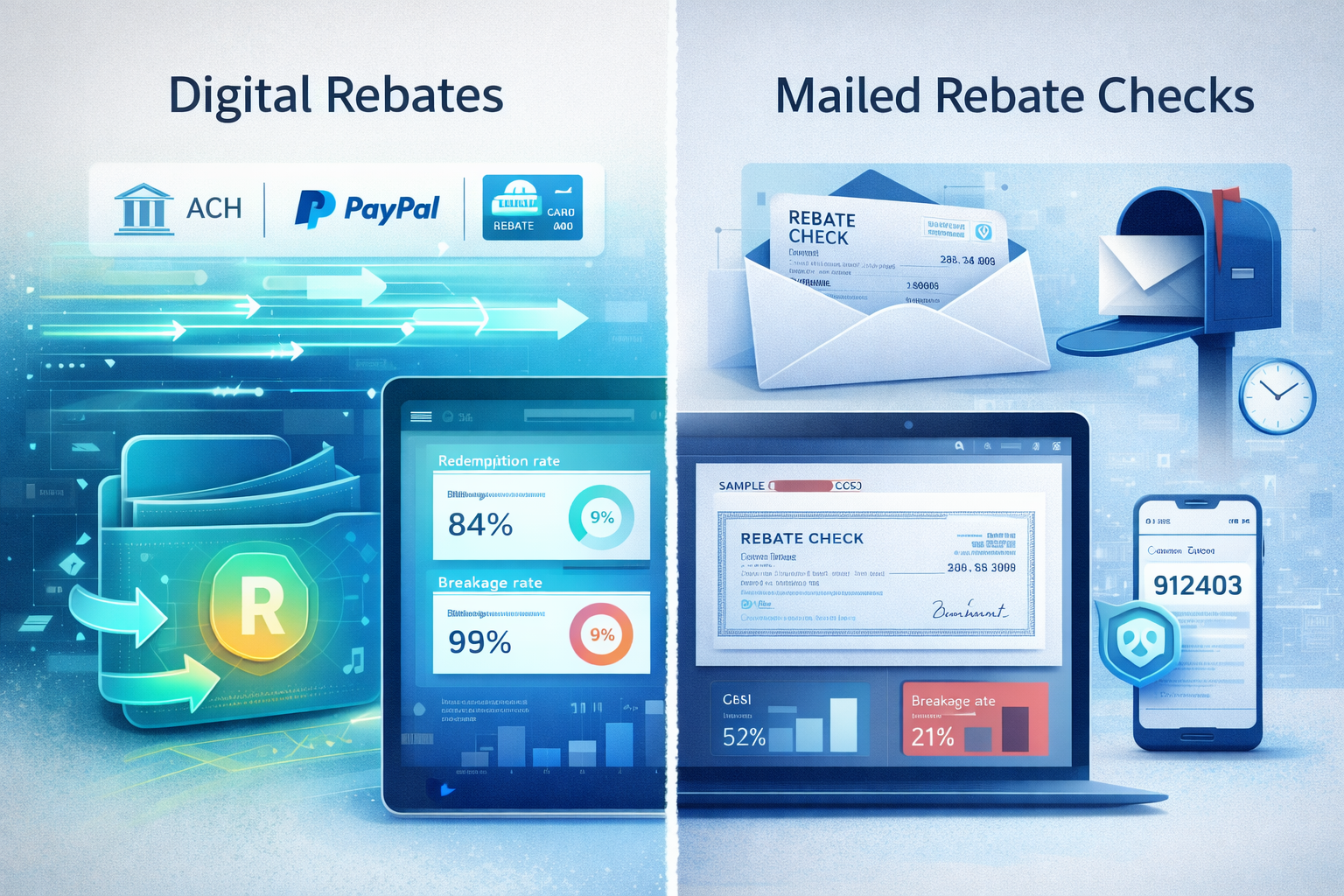
Today, brands typically evaluate digital rebate delivery (ACH, PayPal, digital wallets, virtual cards) versus traditional rebate check mailing as part of a broader rebate program management strategy. Each option carries operational and financial tradeoffs that should be aligned with your rebate processing model, customer demographics, and reporting requirements.
Quick Answer
Digital rebates deliver funds through ACH, PayPal, or digital wallets and typically offer faster delivery and lower breakage. Rebate check mailing provides universal accessibility, higher perceived legitimacy, and often higher breakage rates that can reduce promotional cost. The best payout method depends on audience demographics, fraud exposure, redemption goals, and financial modeling strategy. Many organizations adopt a hybrid rebate model to balance accessibility, cost control, and customer experience.
1. Customer Reach and Accessibility
Digital rebates assume a certain level of digital comfort. Recipients may need to open an email, click a secure link, verify their identity, choose a payout method, and in some cases enter banking information. For digitally fluent audiences, this process feels efficient and convenient.
For others, it introduces hesitation and friction.
Mailed rebate checks, by contrast, are universally accessible. Anyone with a mailing address can receive and deposit a check. No app downloads, no account creation, and no bank credentials entered online. This can be particularly important when targeting broad demographic segments, including older consumers, rural households, or underbanked populations.
If maximizing accessibility and inclusivity is a priority, mailed checks often reduce barriers to completion.
2. Trust and Perceived Legitimacy
Consumer skepticism has increased dramatically in recent years due to phishing scams and digital fraud. When a rebate requires clicking an unexpected email link or entering personal financial information, some recipients disengage — even when the offer is legitimate.
A physical rebate check carries familiarity. It resembles payroll checks, tax refunds, and insurance reimbursements — financial instruments consumers already trust. In industries where credibility and reassurance matter — such as home services, automotive, medical devices, or large-ticket retail — this perception difference can meaningfully affect redemption.
Digital programs must invest heavily in branding, secure messaging, and clear communication to overcome skepticism. Mailed checks often benefit from inherent legitimacy.
3. Speed vs. Completion Rates
Digital rebates clearly outperform checks in speed. Funds can be delivered within minutes or days of approval. This immediacy can boost customer satisfaction and reinforce brand perception as modern and responsive.
However, speed does not always translate to higher completion. Digital delivery typically requires multiple post-approval actions. Each additional step — verification, selection of payout method, account entry — increases abandonment risk.
Mailed checks are slower, often arriving weeks after submission. But once the rebate is approved, the customer usually does not need to take additional action until deposit. In some segments, the simplicity of “wait and receive” reduces friction and improves actual completion rates.
4. Breakage: A Major Financial Lever
Breakage refers to rebates that are issued but never redeemed. This is one of the most significant financial differences between payout methods.
Paper checks historically experience higher breakage rates. Consumers may forget to deposit the check, misplace it, discard it as junk mail, or allow it to expire. Depending on program design and value, check breakage can be materially higher than digital redemption.
Digital rebates — especially direct ACH transfers — tend to have lower breakage because funds are either deposited automatically or claimed quickly. Virtual cards and wallet options also typically outperform paper checks in redemption rate.
From a financial modeling standpoint, higher breakage reduces total payout liability and lowers the effective cost of a promotion. Lower breakage increases program expense but can enhance customer goodwill and perceived value.
Organizations must determine whether their priority is maximizing redemption and customer satisfaction or optimizing promotional cost efficiency. Breakage assumptions should be built explicitly into ROI models and accrual forecasting.
5. Fraud Risk and Operational Controls
Fraud profiles differ significantly between digital and mailed checks.
Digital rebates allow for modern fraud prevention tools: identity verification, device fingerprinting, velocity controls, duplicate detection, and automated anomaly monitoring. These controls can significantly reduce organized abuse.
However, digital systems are also targets for sophisticated exploitation if not properly secured.
Check programs avoid certain digital fraud vectors but introduce physical risks: address manipulation, mail interception, stolen checks, and reissue abuse. Strong address validation, positive pay banking controls, and structured stop/reissue workflows are essential.
Your fraud exposure history should heavily influence payout method decisions.
6. Cost Structure: Visible and Hidden
Surface-level cost comparisons — printing and postage versus transaction fees — rarely tell the full story.
Digital payouts carry processing fees, potential wallet distribution fees, and often increased customer service contacts related to access issues or expired claim links.
Check mailing includes stock, printing, postage, fulfillment handling, and reissuance for stale-dated or lost checks.
Breakage materially affects cost structure. Higher breakage in check programs may offset mailing expenses. Lower breakage in digital programs increases total payout expense but may reduce complaint volume.
A proper analysis should calculate cost per successfully redeemed rebate, not simply cost per issued payment.
From a rebate management perspective, payout method selection also affects internal processing costs, reconciliation workflows, and customer support volume. Digital rebates often streamline rebate processing through automated issuance, real-time status tracking, and simplified reporting. Mailed rebate checks, while operationally familiar, typically require more manual rebate fulfillment steps, including print handling, postal tracking, and reissue management. Evaluating cost per redeemed rebate — not cost per issued payment — is essential for accurate rebate program management and ROI modeling.
7. Reporting, Forecasting, and Liability Timing
Digital rebates provide near real-time visibility into issuance, redemption, and outstanding liability. This allows for faster optimization cycles and more precise financial forecasting.
Mailed checks can be reconciled effectively but often involve longer and less predictable deposit timing. A check may remain outstanding for months before being cashed, complicating accrual management.
Finance teams should evaluate how payout timing affects working capital, liability reserves, and revenue recognition policies.
8. Customer Experience and Brand Perception
Digital payouts can feel flexible and modern, particularly when recipients can choose their preferred method. Offering options such as ACH, PayPal, or virtual cards increases perceived convenience.
Mailed checks create a tangible experience. Receiving an envelope containing a physical check can reinforce value and legitimacy. However, long wait times without clear communication can damage satisfaction.
Regardless of method, proactive status updates and transparent timelines are critical to protecting brand reputation.
9. The Strategic Case for a Hybrid Model
Many organizations find that offering both digital and mailed check options produces the strongest overall results. Providing choice expands accessibility, reduces friction for digitally hesitant recipients, and captures higher redemption among digitally active users.
A hybrid model does introduce operational complexity — two payout rails, two reconciliation paths, and dual support processes. But for high-volume programs, the increase in completion and reduction in complaints often justifies the added infrastructure.
Digital Rebates vs. Rebate Check Mailing
Digital rebates offer speed, automation, and real-time reporting that can simplify rebate processing and improve forecasting accuracy. Mailed rebate checks provide broad accessibility, strong consumer trust, and higher breakage rates that can materially influence rebate program economics.
Neither method is universally superior. The right approach depends on your audience, fraud controls, financial objectives, and internal rebate management capabilities.
For many organizations, the most effective rebate program management strategy is a hybrid rebate fulfillment model that supports both digital and check payouts while maintaining centralized reporting and controls. Aligning delivery method with customer behavior — and structuring rebate processing workflows accordingly — ensures higher completion rates, stronger financial visibility, and a better overall customer experience.
If your team is evaluating digital versus check payouts, optimizing rebate processing workflows, or looking to improve reporting and cost control, our rebate management and rebate fulfillment solutions provide end-to-end support — from claim intake through payment delivery and reconciliation. Contact us or schedule a consultation to design a rebate processing model aligned with your program goals.
Key Takeaways
1. Digital rebates offer faster delivery but may introduce completion friction
Digital payouts (ACH, PayPal, wallets) are delivered faster and provide real-time visibility, but additional authentication steps can increase abandonment risk.
Supporting Source:
Federal Reserve Financial Services – Digital payment adoption trends
https://www.federalreserve.gov/paymentsystems/fr-payments-study.htm
2. Mailed rebate checks remain broadly accessible and trusted
Paper checks remain widely used in the U.S., especially among older and underbanked populations, supporting their continued relevance in incentive programs.
Supporting Source:
FDIC – National Survey of Unbanked and Underbanked Households
https://www.fdic.gov/analysis/household-survey/
Federal Reserve – Use of checks in U.S. payments
https://www.federalreserve.gov/paymentsystems/checks.htm
3. Breakage materially affects rebate program economics
Unredeemed rebates (breakage) reduce total payout liability and significantly impact ROI modeling and accrual forecasting.
Supporting Source:
Harvard Business Review – The Hidden Costs of Rebates
https://www.linkedin.com/pulse/hidden-cost-rebates-what-can-you-do-jay-artil-pe-mba/
GAAP Revenue Recognition & Breakage Guidance (ASC 606 context)
https://asc.fasb.org
4. Digital systems enable stronger fraud controls
Digital rebate platforms can incorporate identity verification, device fingerprinting, duplicate detection, and anomaly monitoring to reduce abuse.
Supporting Source:
AFP Payments Fraud and Control Survey
https://www.financialprofessionals.org/training-resources/resources/survey-research-economic-data/details/payments-fraud
5. Check programs introduce physical fraud exposure
Mail theft and check fraud remain significant risks, requiring Positive Pay and address validation controls.
6. Breakage and payout timing impact working capital and liability forecasting
Outstanding rebate liabilities affect accrual timing, revenue recognition, and working capital strategy.
Supporting Source:
Gartner Finance Research – Liability forecasting and accrual management
https://www.gartner.com/en/finance
7. Hybrid payout models can increase overall redemption and reduce complaints
Providing payment choice improves perceived convenience and accessibility, often improving completion rates across broader demographics.