
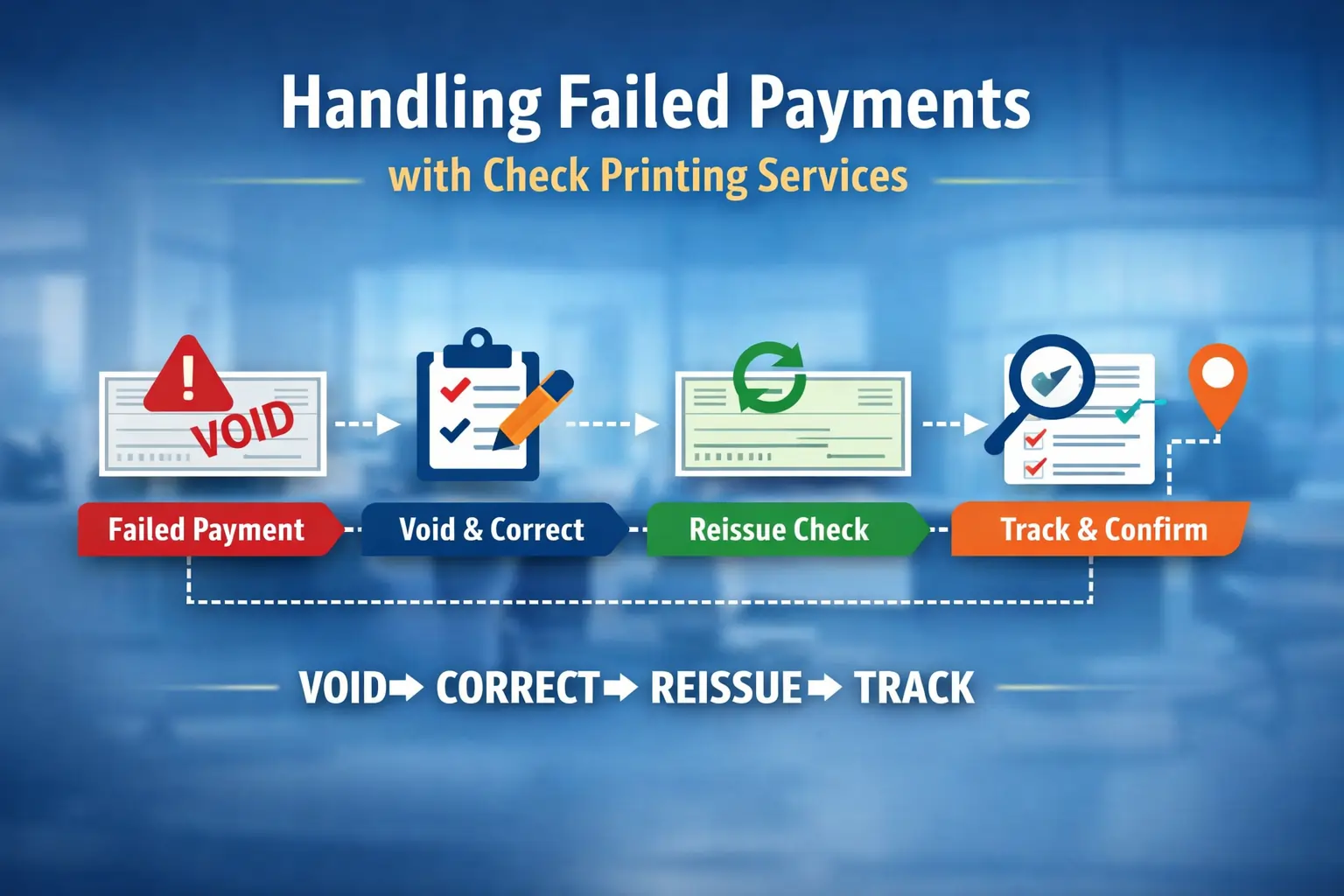
A returned or failed payment is more than an inconvenience. It hurts cash flow, makes it harder to work with vendors, and takes up hours that finance teams don’t have to spare. Payment failures happen. The real question is whether your business responds with a lot of manual work that isn’t organized or a controlled process that can handle them quickly. Modern check printing services and supporting software tools can turn a painful reissuance workflow into something repeatable.
Quick Answer Summary
Businesses handle returned or failed payments by using check printing services and software to quickly void, correct, and reissue payments while maintaining tracking, audit trails, and delivery visibility.
Key Takeaways
- Failed payments often result from incorrect payee data, delivery issues, or processing errors¹
- Manual correction workflows increase errors, delays, and fraud exposure²
- Check printing services streamline void-and-reissue processes with centralized data and audit trails³
- Address validation and mail tracking improve delivery success and reduce reissuance needs³
- Payment tracking systems help detect fraud and prevent repeat errors over time²
Common Reasons Payments Are Returned or Fail
Understanding why payments fail is the first step toward fixing them faster. Each failure type creates a distinct correction challenge, and treating them all the same is part of why manual workflows struggle.
Incorrect Payee Details
Wrong names, outdated addresses, or inaccurate banking information account for a significant share of failed payments. Mail becomes undeliverable when an address can’t be matched to the addressee, often because a recipient moved or the address was incomplete from the start. These cases are routine and generate correction requests at scale.
Delivery Issues
Even correctly addressed checks can fail to reach recipients. Lost mail, intercepted checks, and check washing are genuine operational risks.
U.S. Postal Inspection Service data shows Postal Inspectors recover more than $1 billion in counterfeit checks and money orders annually. These are stolen checks altered before deposit. When a payment goes out and doesn’t arrive, finance is left reconstructing what happened with limited visibility into where things broke down.
Processing Errors
Data entry mistakes, signature issues, and insufficient funds round out the picture. They’re also the failure type most likely to recur if the underlying payee data isn’t corrected at the source.
The Operational Impact of Manual Correction Workflows
When a payment fails, the fix rarely ends with reprinting a check. Manual correction workflows generate their own layer of work and risks.
Time Drain and Error Risk
Finance teams must verify the reason for the failure, trace the original transaction, void and reissue, notify the payee, and confirm that the replacement was actually delivered. Re-keying data manually also reproduces the conditions that led to the original mistake. If the vendor record was wrong in the first place, correcting from memory or an email chain doesn’t reliably fix anything.
According to AFP’s 2025 payments fraud survey, only 22% of organizations recovered 75% or more of funds lost to payments fraud, while 20% recovered nothing at all. Some of that reflects how hard it is to act quickly without a clear status trail.
Poor Visibility and Vendor Frustration
Without centralized tracking, knowing the status of a reissued payment means calling the bank or waiting to see if a vendor follows up. Suppliers experiencing delayed corrections don’t care whether the holdup is due to a data error or a manual backlog. They experience it as unreliability, and it affects the working relationship.
How Check Printing Services Streamline Payment Reissuance
The shift that check printing services offer comes down to consistency. Instead of rebuilding each exception by hand, finance teams work from a controlled issue file with accurate payee data already on record. Key advantages include:
- Centralized access to original payment data, so corrections start from a verified source
- Void and reissue workflows that don’t require involving multiple departments
- Automated audit trails for compliance and reconciliation
- Fewer handoffs, which is where manual correction workflows introduce second-layer errors
A vendor payment returned due to an address error can be corrected in hours rather than days. Additionally, the updated record prevents the same error on future payments.
The Role of Check Printing and Mailing Service in Reliable Delivery
Getting the check right is only half the problem. A check printing and mailing service brings delivery infrastructure to what many businesses still handle informally.
USPS Informed Visibility Mail Tracking provides near-real-time status on domestic barcoded mail, which means a mailing partner with that data can answer a basic but operationally important question: Was the check sent, flagged as undeliverable, or corrected in transit?
Built-in address checks matter earlier in the process than most teams realize. USPS says its Address Element Correction process resolves about 51% of problematic addresses, which helps catch bad data before a check is even mailed. That is a real advantage in a payment environment where fraud remains common. For companies using check printing services, clear mailing records also make it easier to trace a payment, verify delivery details, and investigate anything that looks off.
How Check Writing Software Improves Tracking and Control
Check writing software addresses the documentation problem underlying every failed payment. Without a reliable issue history, teams spend time reconstructing what happened instead of fixing it.
Good software creates a record of every payment, like issued, voided, reissued, delivered, and deposited. That matters beyond reconciliation.
The AFP data also show that vendor impostor fraud accounted for 45% of cases in 2024. This means reissue requests are being reviewed more closely. Some are real. Some are not. Keeping a clear record of payments and approvals helps you spot anything strange before money moves again. At the same time, platforms that give live status updates make it less necessary to look for confirmations in emails or bank systems.
How Check Printing Software Reduces Repeat Errors Over Time
The longer-term payoff from check printing software is consistency. Speed matters in reissuance, but what makes the process sustainable is reducing the failures requiring correction in the first place.
Data validation rules catch incomplete addresses, mismatched payee names, and invalid account formats before a check is generated. A centralized vendor database keeps payee information consistent across every payment. Error logs turn repeated failures into patterns that finance can act on rather than isolated incidents to react to.
According to AFP, more than 75% of organizations have no plans to reduce check usage in the next two years. The check correction problem isn’t going away; what changes is whether teams are managing it with tools built to reduce preventable failures and resolve unavoidable ones faster.
Let Us Help You Build a More Reliable Payment Process
Failed payments are inevitable. The operational chaos of handling them manually is not. The gap between those two realities comes down to infrastructure: consistent check printing services, intelligent check writing software, and a reliable check printing and mailing service that brings real delivery visibility into the workflow.
The teams that build this well aren’t just cutting reissuance time. They’re documenting payment history, catching fraud signals earlier, and protecting vendor relationships that took years to establish. If your team is ready to move from reactive fixes to a process that holds up under pressure, contact us, call us, or set up a meeting with the experts at CheckIssuing. We’d be glad to show you how it works.
Citations
- U.S. Postal Inspection Service – Check Washing & Mail Theft
https://www.uspis.gov/news/scam-article/check-washing - AFP Payments Fraud Survey (2025 Highlights)
https://www.truist.com/content/dam/truist-bank/us/en/documents/info/cci/2025-afp-payments-fraud-control-survey-report-key-highlights.pdf - USPS – Address Element Correction (AEC II)
https://postalpro.usps.com/address-quality/aec-II