
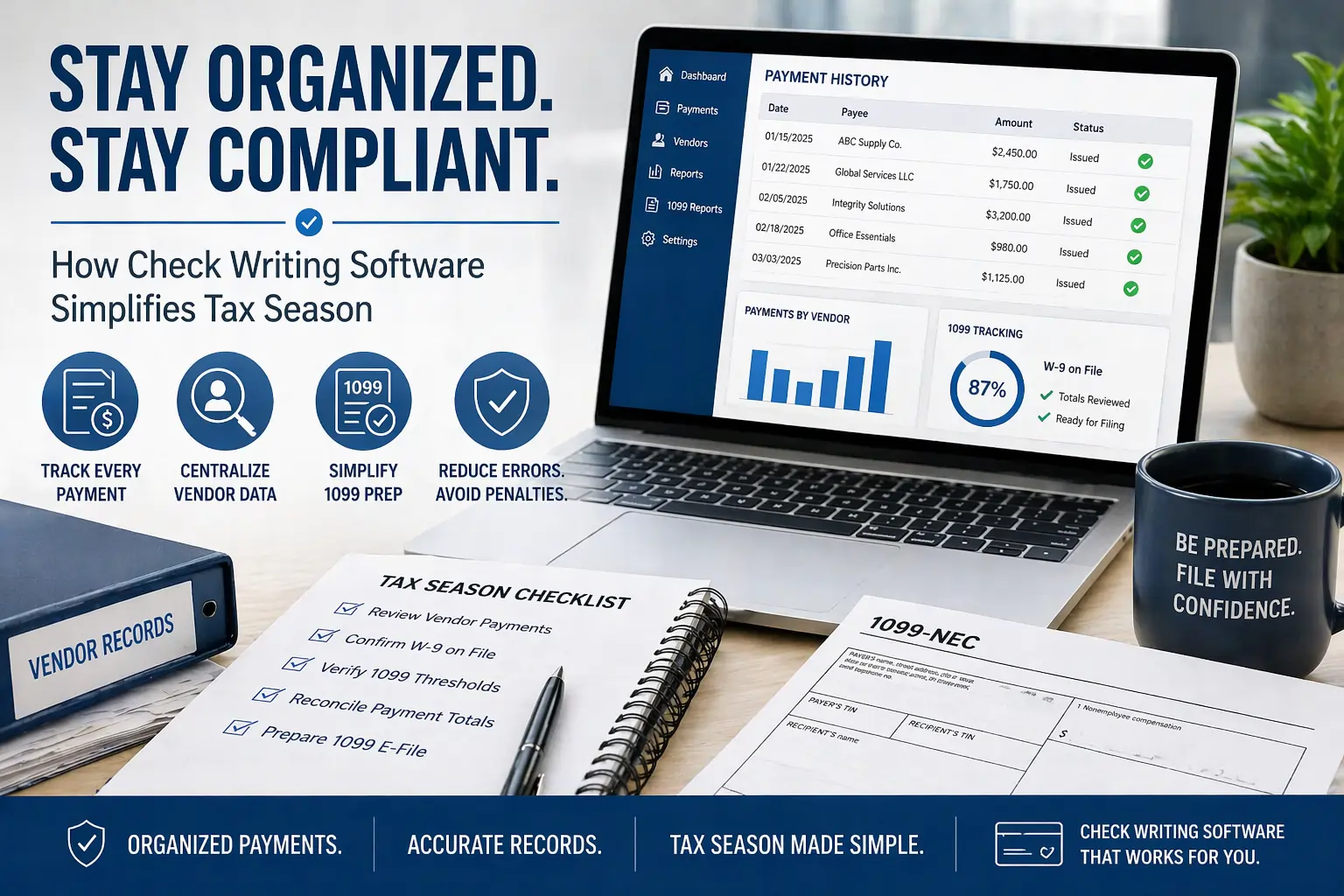
Filing returns is only part of tax season. The harder part, for most finance teams, is proving what was paid, to whom, under what taxpayer data, and whether those records hold up when it’s time to report.
When payments are scattered across bank portals, spreadsheets, and email chains, building that proof under deadline pressure takes real effort. Check writing software changes that by turning every issued payment into a structured, accessible record, the kind of organized foundation that makes 1099 e-file preparation and compliance review far less reactive.
Quick Answer Summary
Check writing software helps businesses stay organized during tax season by centralizing payment records, simplifying 1099 preparation, reducing errors, and ensuring compliance with IRS reporting requirements.
Key Takeaways
- Centralized payment records make tax reporting and audits faster and more accurate¹
- Organized workflows reduce errors that can lead to IRS penalties²
- Structured data simplifies 1099 e-file preparation and vendor tracking¹
- Payment visibility helps detect fraud and verify transactions more efficiently³
- Consistent recordkeeping minimizes manual work during tax deadlines²
The Real Tax Season Challenge Is Recordkeeping
The IRS expects businesses to maintain books and supporting documents that clearly substantiate what appears on a return, and to keep them for at least three years in most cases, often longer depending on the situation.
In practice, payment data rarely lives in one place. It accumulates across bank portals, approval emails, handwritten logs, and PDF invoices until the pressure of tax season forces someone to reconstruct it all at once. That’s the real friction point. Finance teams are doing more than filing. They’re rebuilding records they should already have.
Check writing software centralizes what would otherwise stay fragmented. Each issued check becomes part of a searchable transaction history tied to payee details, amounts, dates, and supporting context. That structure doesn’t just simplify bookkeeping. During tax season, it becomes documentation, the audit trail behind every number on a return.
How Check Writing Software Creates a Centralized, Searchable Payment Trail
The value here isn’t just automation. It’s visibility.
When businesses use check writing software online, every payment creates a permanent record of the payee’s name, amount, date, and remittance details. That record doesn’t disappear into a file drawer or get manually updated each time a vendor changes. It stays searchable and tied to the payee, accessible from wherever the finance team is working.
During tax season, that accessibility matters. Core questions, like “How much did we pay this vendor this year?”, “Was a W-9 collected before the first payment?”, and “Does this total match what’s going on the 1099?” get answered quickly instead of slowly.
The time between “What did we pay?” and “What do we report?” is where most tax season delays originate. A centralized payment trail compresses that gap considerably, especially as payee counts grow.
From Payment Records to 1099 Prep
Organized payment data and clean 1099 preparation aren’t separate workflows. They’re sequential ones.
When vendor records stay connected to payment history, identifying who needs a 1099 is straightforward. Finance teams can review totals by payee, flag anyone crossing the filing threshold, and confirm W-9 status before deadlines arrive.
The IRS requires businesses to collect W-9 forms before filing information returns, and offers TIN Matching so authorized payers can verify name and taxpayer identification number combinations before submission. It also mandates backup withholding in certain situations when that data is missing or incorrect.
None of those requirements is difficult to manage when payee data is organized and current. Check writing software keeps the payment side structured so the reporting side doesn’t have to start from scratch each January.
Connecting Check Printing Software to 1099 E-File Workflows
Check printing software keeps vendor data, like payee name, address, and taxpayer information, consistent across both payment records and reporting fields. When that consistency is built in from the start, feeding totals into 1099 filing software becomes a cleaner process. Less manual re-entry. Fewer data mismatches between the payment record and the form.
The IRS IRIS Taxpayer Portal, which handles 1099 e-file submissions for businesses filing 10 or more information returns, accepts structured data, including CSV uploads. Businesses that manage payments through a centralized check-writing and mailing services platform already have that structure in place. The underlying vendor and payment data don’t need to be rebuilt before submission because it’s already organized.
Tight Deadlines Make Organization a Strategic Advantage, Not a Luxury
Form 1099-NEC is due January 31. Form 1099-MISC carries a March 31 electronic filing deadline.
Disorganized teams typically discover missing W-9s or mismatched TINs right before those cutoffs, when there’s no clean window to resolve them. Businesses using check-writing software online can review vendor payment totals throughout the year rather than reconstructing them in a sprint.
For teams managing dozens or hundreds of payee relationships, that ongoing visibility isn’t just a convenience. It’s the difference between orderly preparation and last-minute exception handling that bleeds into the filing window.
Reducing Errors and Avoiding Penalties Through Structured Workflows
Errors in information returns are common, and the IRS has detailed correction procedures for them: covering wrong amounts, incorrect TIN or name combinations, duplicate reporting, and the wrong form type altogether.
The penalties for getting it wrong are specific. For returns due in 2026, they range from $60 per return when corrected within 30 days to $680 per return for intentional disregard.
Most information return errors trace back to manual rekeying and inconsistent payee data, exactly what check printing software addresses by standardizing how records are captured. That same consistency makes corrections easier to trace if a mistake surfaces later. When payment documentation and filing workflows share one system, like integrated 1099 services, there’s far less room for things to fall between the cracks.
Why Organization Also Protects Against Check Fraud During Tax Season
Check fraud remains a significant operational risk. According to AFP’s 2026 payments survey, 58% of organizations reported check fraud in 2025, making checks the payment type most frequently affected. FinCEN separately documented more than $688 million in suspicious activity tied to mail-theft-related check fraud during a single six-month review period.
Tax season is when payment volume rises, and finance teams are already stretched. That combination creates real exposure. Controlled, trackable check issuance through check writing software helps match every payment to documented payee records, which matters both for fraud detection and year-end reconciliation.
When every issued check has a traceable record, anomalies surface earlier. And when something needs to be defended or corrected later, the documentation is already there.
Let Us Help You Build an Integrated, Tax-Ready Payment Workflow
Tax season organization isn’t about working harder. It’s about connecting the right systems so payment issuance, recordkeeping, and 1099 e-file workflows aren’t running on separate, disconnected tracks.
At CheckIssuing, we provide the tools that bring those workflows together: check writing and printing software, as well as integrated 1099 online filing service solutions that give finance teams a centralized, audit-ready foundation. Payments are documented from the moment they’re issued. Vendor records stay current. Reporting is faster because the data is already structured before the filing season arrives.
Ready to stop rebuilding payment histories from scratch every January? Contact us today, call us, or set up a meeting with the team to learn how CheckIssuing can help your team build a more organized, tax-ready payment operation before the pressure starts.
Citations
- IRS – Information Return Penalties
https://www.irs.gov/payments/information-return-penalties - AFP Payments Fraud Survey
https://www.financialprofessionals.org/training-resources/resources/survey-research-economic-data/details/payments-fraud - FinCEN – Check Fraud & Suspicious Activity Report
https://www.fincen.gov/system/files/shared/FTA-Check-Fraud-FINAL508.pdf