
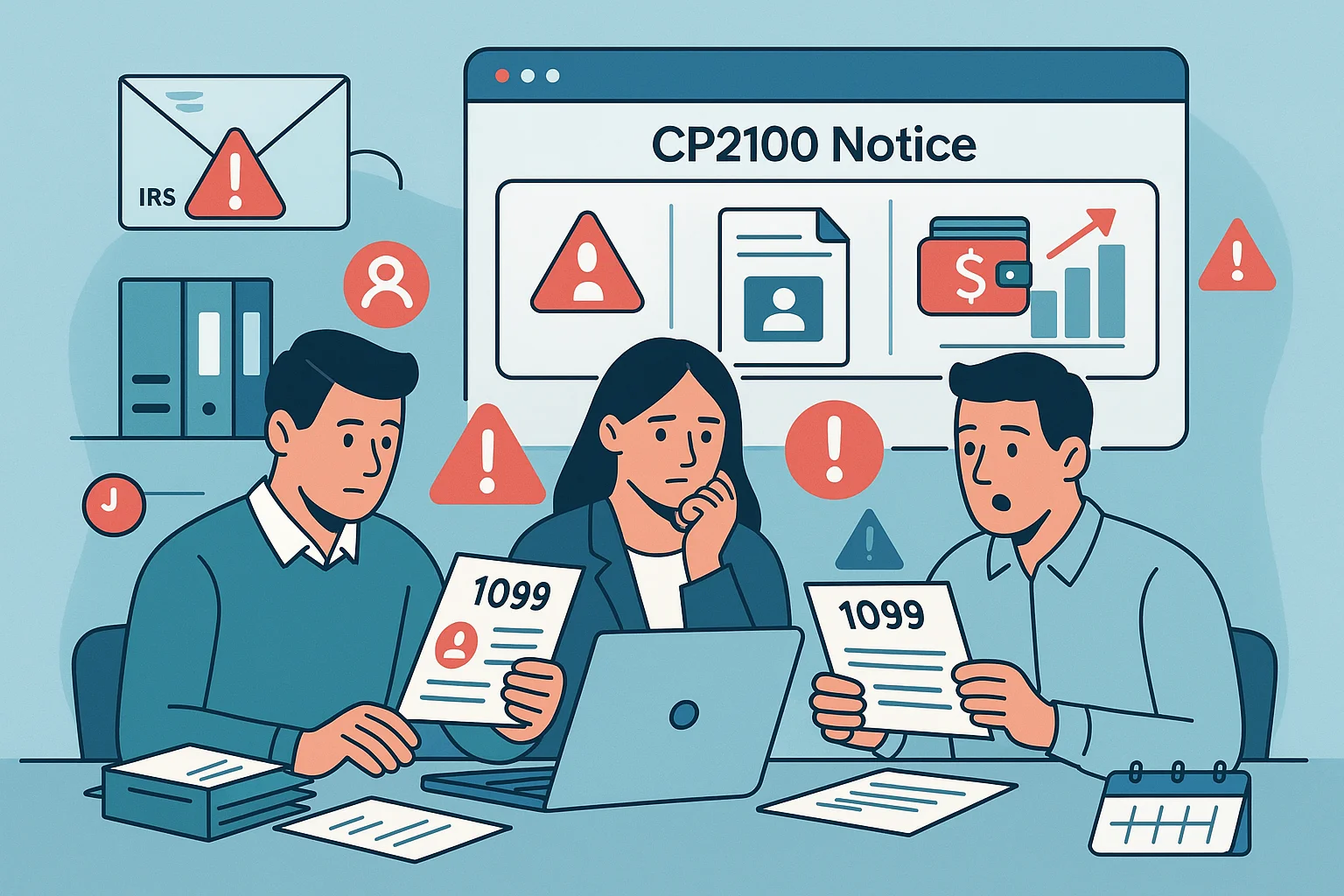
Most teams think of 1099s as quick year-end paperwork, right up until a small mistake turns into penalty letters and surprise administrative cleanup. The IRS tightened its rules in recent years, including the shift to mandatory electronic filing once a business hits ten information returns.
Even tiny inaccuracies travel far once they enter that system. A few hours of sloppy data entry can ripple out into weeks of follow-up; because of that, many companies now rely on 1099 processing support to keep January from spinning out of control.
Quick Answer
Filing a 1099 late or with errors can trigger IRS penalties starting at $60 per form, rising to $340 per form after August 1, with $680 per form for intentional disregard, with no maximum cap. Mistakes such as incorrect TINs, incorrect form types, or missing payee statements can also lead to CP2100 notices, backup withholding at 24%, and significant administrative cleanup.
Why 1099 Mistakes Are Increasing, and Why the Stakes Are Rising
The number of 1099 types has grown, and each carries its own instructions. There’s also the IRS’s electronic filing platform, IRIS, which quietly raised the bar for accuracy. Once filings pass through that system, mismatches surface fast.
Below are some of the trends that sit at the center of this shift:
- The ten-return filing threshold means even small teams must follow electronic specs.
- Form 1099-NEC now covers most contractor payments, while Form 1099-MISC handles everything else, yet both circulate at the same time.
- Newer forms, like the 1099-DA for digital asset activity, increase the risk of confusion.
The IRS can now spot inconsistencies at a level that wasn’t possible a decade ago. That alone changes how businesses should prepare for tax season.
The Real Financial Penalties
Once a filing is sent incorrectly or doesn’t go out at all, penalties start stacking up. And they don’t stay small.
Late Filings
The penalty for a late 1099 starts at $60 per form if corrected within 30 days. That amount grows to $130 after the first window, and it jumps again to $340 per form if nothing is corrected after August 1. These numbers apply to 2025 filings.
What often gets overlooked is that furnishing the payee statement is subject to a separate set of penalties. One missed deadline can turn into two.
Incorrect Forms
Incorrect amounts, wrong payer details, or selecting the wrong type of 1099 count as filing an “incorrect information return.” The IRS does not consider inaccurate TINs minor errors because those trigger penalties on their own. One flawed spreadsheet can multiply into dozens or hundreds of fines because everything is calculated per form.
Intentional Disregard
The harshest category kicks in when the IRS determines a business knowingly failed to file. Those penalties begin at $680 per form, with no maximum. A company issuing contractor payments year-round could see an enormous bill if the agency treats the filing process as neglect rather than error.
The Cost of Common Errors
The penalties above make more sense once you see the mistakes that usually trigger them. Some of these mistakes are addressed below.
TIN Mismatches
A wrong TIN can start an entire chain reaction. First comes the CP2100 notice. Then the business must issue B-notices, document the outreach, and sometimes begin backup withholding at 24% if the recipient does not respond. That creates more tracking, more adjustments, and more forms, usually at the worst possible time of year.
Wrong Form Types
The split between 1099-NEC and 1099-MISC confused many teams at first, and it still does. A contractor payment filed on the wrong form affects both the IRS’s matching process and the recipient’s books. These mistakes tend to show up when payables and payroll aren’t in sync or when accounting codes don’t clearly map to 1099 rules.
Worker Misclassification
A worker treated as a contractor rather than an employee sets off a different type of problem. It goes past an incorrect 1099. Businesses may owe missing payroll taxes and could face accuracy-related penalties. Fixing misclassification involves amending records across multiple systems, not just filing a corrected form.
The Hidden Operational Drain
Money isn’t the only thing on the line. The administrative weight can feel heavier.
Corrections
Correcting 1099s isn’t as straightforward as people expect. The IRS has different procedures depending on whether the original error involved dollar amounts, payee information, or the payer’s own details.
Teams often spend hours tracking down updated records, reissuing corrected statements, and resubmitting digital files. When the correction period stretches into August, the work becomes even more stressful because penalties increase after that point.
CP2100 Cycles
Responding to a CP2100 notice can take a small finance team an entire week. Each contractor must be logged, tracked, contacted, and followed up with. If the business must apply backup withholding, it must adjust payments and update ledgers.
Lost Productivity
Contractor calls, confused emails, and mismatched statements are not some of the tasks that appear in a job description. Yet, they eat into planning time and financial reporting. One error can create a string of small administrative fires. A few forms turn into an entire week lost.
How Outsourced 1099 Processing Eliminates Risk and Reduces the Burden
This is where a modern support system changes things. A dependable 1099 service handles the messy parts automatically, including TIN matching, form-type selection, deadline reminders, and payee statement delivery. It helps teams avoid the scramble of pulling old invoices or rechecking spreadsheets right before January deadlines.
Using a 1099 filing service also gives companies a record of what was filed, when it was furnished, and whether corrections were sent. That trail becomes useful if the IRS questions anything later. A good 1099 online filing service reduces the entire process to a cleaner set of steps. Instead of hoping forms were filed correctly, teams can confirm that they were.
Predictability might be the most significant benefit. Internal overtime fades, penalty worries go away, and filing season stops feeling like a crisis waiting to happen.
When Accuracy Matters Most, Choose a Partner Built for Compliance
Accurate reporting protects compliance, builds trust with contractors, affects payment timing, and determines how smoothly year-end projects run. A clean filing season sets the tone for the rest of the year. And when teams already carry heavy workloads, avoiding preventable issues is worth more than it looks at first glance.
CheckIssuing helps companies build a smoother, more reliable reporting workflow through secure data handling, automated checks, and tools that prevent avoidable mistakes. If your team wants support before the next filing deadline, our 1099 processing options are ready to step in and simplify the work.
Reach out to us today, or set up an appointment with the team here, and we’ll help you set up a smarter, penalty-free workflow through our full 1099 online filing service.
Key Takeaways
1. IRS penalties for incorrect or late 1099s escalate quickly.
Late filings start at $60 per form and can reach $340 per form after August 1. Intentional disregard begins at $680 per form with no cap.
Source: https://www.irs.gov/payments/information-return-penalties
2. TIN mismatches create CP2100 notices and trigger backup withholding.
Incorrect TINs require issuing B-notices, documenting outreach, and possibly withholding 24% from future contractor payments.
Sources:
CP2100 Notices – https://www.irs.gov/individuals/understanding-your-cp2100-or-cp2100a-notice
Backup Withholding – https://www.irs.gov/businesses/small-businesses-self-employed/backup-withholding
3. Wrong form types—especially NEC vs. MISC—cause mismatches and penalties.
Misfiled contractor payments disrupt IRS matching and must be corrected, doubling taxpayer and administrative workload.
4. Worker misclassification leads to far larger liabilities than corrected 1099s.
Incorrectly treating employees as contractors exposes businesses to payroll tax adjustments and accuracy-related penalties.
5. Errors create a heavy operational strain beyond the fines themselves.
Responding to CP2100 cycles, issuing B-notices, and tracking corrections consume days of team capacity and disrupt year-end planning.
6. Outsourced 1099 services reduce risk and prevent avoidable penalties.
TIN matching, automated validations, correct form selection, and filing confirmations ensure accuracy and reduce IRS exposure.