
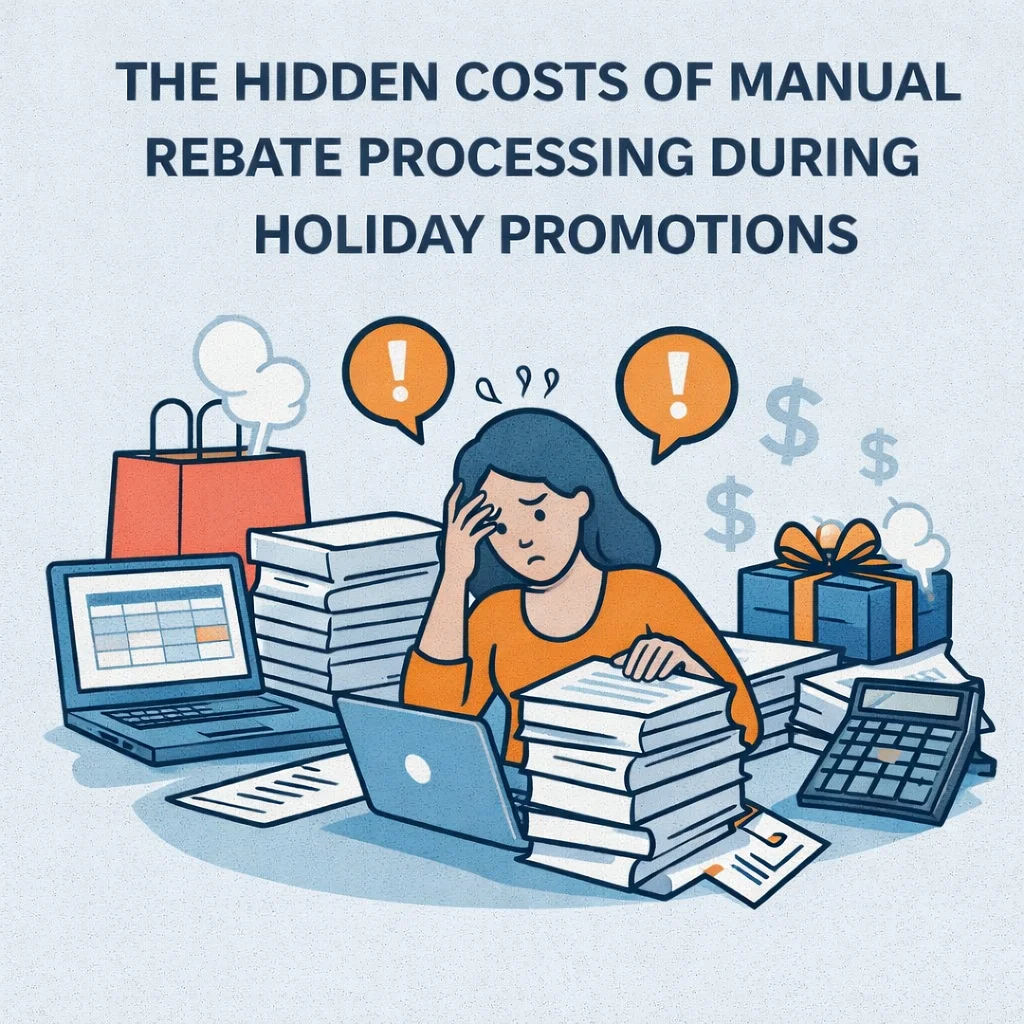
Holiday promotions are designed to create a rush, and they usually succeed. But the same surge that lifts sales can quietly overwhelm rebate processing when the work depends on manual steps, inboxes, and spreadsheets.
At peak volume, minor delays become backlogs, small mistakes become rework, and every unresolved claim turns into a customer experience problem. The result is not just higher labor costs. This mix of leakage, frustration, and avoidable risk lands on finance and operations, even as the season is already compressed.
Why Holiday Promotions Stress Rebate Operations First
Holiday demand is not subtle. The National Retail Federation (NRF) projected U.S. holiday sales of about $1.01–$1.02 trillion for Nov–Dec 2025. Online spending is also expected to remain strong, with Adobe forecasting $253.4 billion in online holiday sales in 2025. That context matters because rebate programs usually ride the same wave: more receipts, more submissions, and more questions arriving all at once.
When a team runs rebate management manually, the system does not “stretch” with volume. It just slows down. Staff can work longer hours, add temps, or shift people from other tasks, but the process itself still moves one claim at a time, with human judgment and human typing as the throughput limit.
The Labor and Time Costs Hidden Inside Manual Rebate Processing
In day-to-day periods, manual handling can feel manageable. During holidays, it becomes expensive in a way that is hard to see until someone calculates it.
One simple way to ground the labor impact is wages. The median hourly wage for data entry keyers was about $19.16 in 2024, and for customer service representatives, about $20.59 per hour (May 2024). Those are not perfect proxies for rebate work, but they map closely to what manual rebate operations require: keying data, verifying documents, and answering “where is my rebate?” contacts.
The deeper issue is that manual work stacks. A single claim can touch multiple hands: intake, review, exception handling, follow-up, approval, and payout. Each touch may be quick. In aggregate, the cost becomes a recurring seasonal spike, especially in B2B rebate management programs where claim values are larger, rules are stricter, and stakeholders expect traceability.
Where Errors, Delays, and Rework Start to Snowball
The fastest way for manual processing to become costly is rework. It is not just the initial handling time. It is the second and third pass after something does not match.
A few patterns show up repeatedly during holiday surges:
- Missing or unclear documentation (receipt does not show the eligible item, date, or retailer clearly)
- Eligibility mismatches (SKU, promo window, quantity thresholds, or region-based terms)
- Duplicate submissions (customers resend after waiting, or multiple contacts submit on the same purchase)
- Address issues (format errors, outdated addresses, or mismatched customer records)
- Exception queues that turn into “someone will look later” piles
Manual environments tend to absorb these issues informally: someone fixes a field, someone emails a customer, someone re-runs a report. That “informal fix” is the problem. It is hard to measure, hard to audit, and easy to repeat.
A structured workflow changes the texture of the work. Instead of relying on individual memory and ad hoc steps, you formalize intake, validation, exception routing, and status tracking. That is the practical difference between a seasonal scramble and an operation that can hold up under pressure, which is the intent behind rebate processing services.
Customer Experience Becomes a Brand Liability During Peak Seasons
Rebates are marketing tools, but customers experience them like a promise. The holiday context makes that promise sharper. People buy with urgency, budgets are tight, and patience is short.
Customer satisfaction data reinforces the point that convenience and value shape how people judge retail experiences. ACSI’s 2025 retail and consumer shipping reporting puts overall retail satisfaction at 78.3, which is a helpful reminder: Customers already have a baseline expectation for how smooth “normal” should feel.
Rebate friction pulls in the opposite direction. Long turnaround times, unclear status, and inconsistent communication can turn a “deal” into a regret, even when the rebate is eventually paid.
It helps to remember how a consumer sees the process. From their side, it is usually simple: submit the claim and wait. The gap between “simple” on the customer side and “messy” on the back-office side is exactly where dissatisfaction grows.
Lost Submissions, Payment Risk, and Fraud Exposure Escalate Together
Holiday rebates often involve physical documents, mail, and check-based payouts. That combination increases risk in three ways: it expands the handling footprint, stretches processing windows, and introduces more opportunities for loss.
Mail risk is not theoretical. USPS OIG reporting has discussed rising mail theft and operational vulnerabilities, which matters because holiday volume increases the amount of mail moving through systems at the same time.
On the fraud side, the broader payments environment is also clear: The AFP’s 2025 Payments Fraud & Control Survey found that checks were the payment method most often targeted, and 63% of respondents said their organizations faced check fraud in 2024.
Rebate programs can become a soft target when they are slow and exception-heavy. Fraud hides in noise. A backlog makes it easier for duplicates, altered documents, and questionable claims to blend in. And when manual teams are racing the clock, the temptation is to “just clear the queue,” which is when controls weaken.
For organizations that still rely on rebate check processing, the practical question is not whether checks can be used. It is whether the intake, tracking, and payout controls around them are strong enough. This is one reason secure intake and documented handling matter in peak season.
How Structured Rebate Management Changes the Cost Equation
A structured rebate processing model reduces touch points and makes exceptions more consistent. Centralized intake helps, whether submissions arrive by mail, upload, or mixed formats.
Automated validation checks reduce the number of claims that reach a human reviewer with obvious issues. De-duplication catches repeats early. Status tracking reduces inbound contacts because people can see the stage of a claim, and internal teams can answer questions without digging through email threads.
This is also where rebate fulfillment services have a clear value proposition. They do not just “send payments.” They turn fulfillment into a governed process with timing, controls, and reporting that can withstand holiday volume.
Turn Holiday Rebates Into a Competitive Advantage
Manual rebate operations can feel “fine” until the holidays arrive, when volume forces every weakness into the open. The hidden cost is that these issues do not stay inside operations. They show up as marketing fallout, financial leakage, and a hard-to-unwind reputation hit when customers feel burned.
CheckIssuing helps teams replace fragile manual handling with controlled, end-to-end rebate processing. If you are planning your next holiday promotion and want your rebate operation to stay fast, accurate, and defensible under peak load, contact us, or set up an appointment with the team here.
Key Takeaways
1. Holiday promotions amplify the weaknesses of manual rebate processing.
With U.S. holiday sales projected to exceed $1 trillion and online spending continuing to grow, rebate volumes spike sharply during peak seasons, overwhelming manual workflows.
Sources:
https://nrf.com/media-center/press-releases/nrf-expects-holiday-sales-to-surpass-1-trillion-for-the-first-time-in-2025
https://business.adobe.com/resources/holiday-shopping-report.html
2. Manual rebate handling carries significant hidden labor costs.
Rebate work relies heavily on data entry, document review, and customer support—roles with median hourly wages near $20—making seasonal volume surges expensive and difficult to scale.
Sources:
https://www.onetonline.org/link/details/43-9021.00
https://www.bls.gov/ooh/office-and-administrative-support/customer-service-representatives.htm
3. Errors and rework multiply quickly under peak volume.
Missing documentation, duplicate submissions, and eligibility mismatches snowball during holidays, creating backlogs that are hard to audit and even harder to control.
4. Rebate delays damage customer experience during high-pressure seasons.
Customer satisfaction already operates at a narrow margin during holidays. Slow or unclear rebate processing turns promotions into brand liabilities rather than loyalty drivers.
Source:
https://theacsi.org/wp-content/uploads/2025/01/25jan_Retail-Study-FINAL.pdf
5. Fraud and payment risk rise alongside rebate backlogs.
Checks remain the most targeted payment method for fraud, and exception-heavy rebate programs provide cover for duplicate, altered, or questionable claims during peak periods.
Source:
https://www.financialprofessionals.org/training-resources/resources/survey-research-economic-data/details/payments-fraud
6. Structured rebate management reduces cost, risk, and customer friction.
Centralized intake, automated validation, and governed rebate fulfillment help teams process higher volumes without sacrificing accuracy, control, or customer trust.