
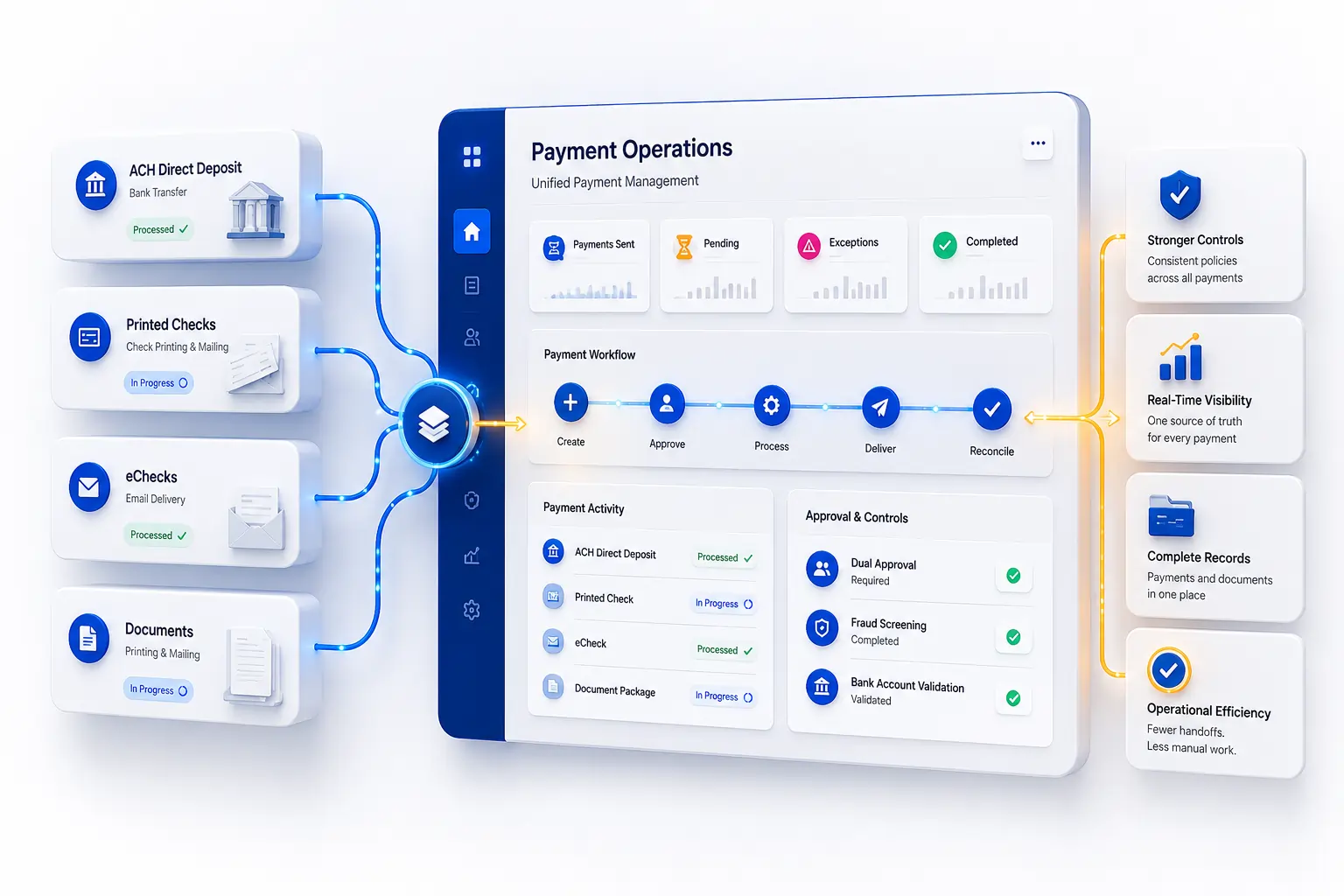
Many businesses rely on both ACH direct deposit service and printed checks at the same time, but manage them through entirely separate systems, vendors, and approval chains. That separation is where the real problems start.
When payment processing workflows are disconnected, finance teams lose visibility, absorb avoidable errors, and spend more time chasing payment status than resolving exceptions. Centralizing how those channels operate is not about replacing one method with another. It is about managing both without building two separate administrative worlds.
Quick Answer Summary
Many businesses manage ACH direct deposit service and printed payments through separate systems, creating visibility gaps, duplicated work, reconciliation challenges, and inconsistent fraud controls. By centralizing ACH, printed checks, eChecks, and supporting documentation into a unified workflow, businesses can improve payment tracking, reduce administrative burden, strengthen security, and create a more reliable payment process.
Key Takeaways
- Businesses that manage ACH and printed payments separately often struggle with payment visibility, tracking, and reconciliation across multiple systems.¹
- Manual handoffs between payment channels increase administrative workload and create opportunities for errors, delays, and missing documentation.²
- Fragmented workflows can weaken fraud controls and make vendor payment changes more difficult to verify consistently.³
- Centralized payment processes help finance teams maintain stronger oversight, clearer audit trails, and more consistent approval workflows.³
- Integrating ACH transfers, printed checks, eChecks, and document delivery into a single workflow improves efficiency and reduces operational friction.¹⁴
Visibility Gaps and Tracking Confusion
When ACH and printed payments live in different systems, answering a basic question like whether a vendor was paid, and through which method, becomes harder than it should be.
ACH payment status typically lives in a bank portal or payment file log. Printed check status may exist in a spreadsheet, a mailing batch record, or a separate accounting entry. Neither system talks to the other by default.
The Federal Reserve’s 2025 Business Payments Study found that 73% of businesses used checks and 71% used ACH in the prior 12 months, meaning mixed-payment environments are the norm. But when those channels are tracked separately, support teams end up searching across portals, email approvals, and check batches just to confirm what happened to a single payment. That search takes time that should be going elsewhere, and it gets worse during audits, high-volume periods, and vendor disputes when there is no single source of truth to pull from.
Manual Handoffs and Administrative Strain
Separate workflows tend to mean the same payment data gets entered, exported, reformatted, and reconciled in multiple places. Each handoff is another opportunity for something to go wrong.
When ACH direct deposit service and check printing and mailing processes run on separate tracks, finance teams end up doing more than just issuing payments. They rebuild the same data in different formats, manage delivery through separate channels, and piece together a complete payment picture at the end of the month from records that were never designed to work together.
The AFP 2025 Digital Payments Survey found that checks still account for 26% of B2B payments, down from 33% in 2022, and 76% of organizations plan to update their payments strategy within the next three years. That trajectory makes sense, but it does not resolve the near-term reality.
Printed payments are still moving, and without better coordination around them, errors accumulate. Address mistakes on mailed checks, ACH returns from outdated bank data, and missing remittance documentation tend to follow from a process that was never built to handle both channels at once.
Inconsistent Fraud Controls and Compliance Risks
Siloed payment workflows tend to apply different standards depending on the payment type. One process may require multi-step approval for ACH, while printed checks move through a looser review. That inconsistency is a real exposure.
Payment fraud is not a fringe concern. AFP’s 2024 data puts it at 79% of organizations, with checks taking the hardest hit at 63% and ACH credits seeing BEC exposure grow from 47% to 50%.
Vendor impersonation works particularly well against fragmented processes. A bank detail change request that comes through email, gets approved informally, and then gets applied inside a check workflow that sits outside the ACH approval chain has no natural checkpoint. Centralized payment processing closes that kind of gap by making it easier to apply consistent controls and maintain a clear record of who approved what and when.
Compliance carries its own pressure here. The IRS now requires electronic filing for businesses submitting 10 or more information returns in a calendar year. When payment records and mailed tax forms live in different systems, building an accurate year-end picture takes longer than it should and creates more room for gaps.
How Modern Solutions Bridge the Gap
Bringing payment channels together does not mean forcing every recipient onto ACH or abandoning checks entirely. It means building a workflow where the right method can be selected without triggering a separate administrative process each time.
Check Printing and Mailing Services
Outsourced check printing and mailing removes the internal production burden without removing the payment option. Check printing and mailing covers production, postage, and delivery on the business’s behalf, which means a printed check can be issued from the same workflow as an ACH transfer rather than a separate queue managed by a different team.
USPS noted in 2025 that First-Class Mail delivery would not exceed 5 days, with a 2 to 3-day turnaround in some regional and local areas. That delivery window matters when recipients expect payment and documentation to arrive in sync.
eChecks and Digital Checks
Some recipients are not yet set up for ACH, and paper is not the only alternative. eChecks and digital checks sit squarely between the two. An email check functions like a paper check in structure but moves electronically, processes faster, and generates a clearer tracking record. For recipients who are familiar with checks but open to receiving them digitally, it reduces the lag of physical mail without requiring a full ACH setup on their end.
Document Printing and Mailing Services
A payment and its accompanying paperwork need to arrive together to be useful. When document printing and mailing services operate separately from payment execution, recipients end up receiving a check without remittance detail or an ACH credit with no documentation explaining what it covers. A document printing and mailing service that runs within the same workflow as payment issuance keeps those pieces aligned, reduces back-and-forth with recipients, and produces cleaner records on both sides.
Let Us Help You Unify Your Payment Operations
The challenges covered here share a common root. Separate systems produce separate problems, and those problems tend to grow quietly until they surface during a dispute, an audit, or a period of high payment volume.
Bringing ACH and printed payment operations into a more coordinated workflow is not a complex undertaking. It is a structural one. CheckIssuing is built to support businesses that need reliable ACH direct deposit service, flexible printed payment options, and the operational visibility to manage both without friction. Contact us, call us, or set up a meeting with the experts at CheckIssuing to talk through what that looks like for your team.
Citations
- Federal Reserve Banks. Business Payments Coalition – 2025 Business Payments Survey Report. Available at: https://fedpaymentsimprovement.org/wp-content/uploads/business-payments-report.pdf
- Association for Financial Professionals (AFP). 2025 Digital Payments Survey. Available at: https://www.financialprofessionals.org/training-resources/resources/survey-research-economic-data/Details/digitalpayments
- Association for Financial Professionals (AFP). 79% of Organizations Were Victims of Attempted or Actual Payments Fraud Activity in 2024. Available at: https://www.financialprofessionals.org/about/learn-more/press-releases/Details/survey-79-percent-of-organizations-were-victims-of-attempted-or-actual-payments-fraud-activity-in-2024
- United States Postal Service (USPS). USPS Is Enhancing Service Standards. Available at: https://about.usps.com/newsroom/national-releases/2025/0320-usps-is-enhancing-service-standards.htm