
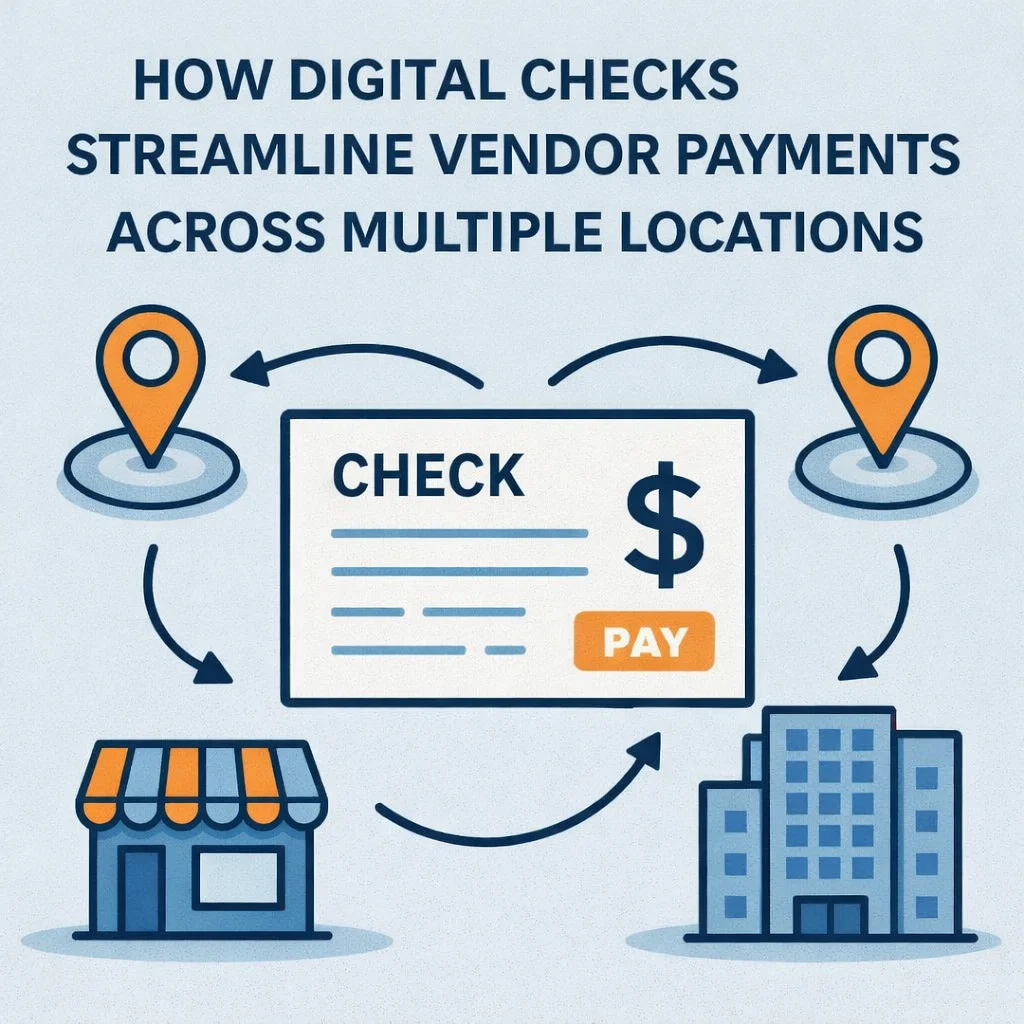
Paying vendors is rarely the hard part. Paying them consistently when work happens across offices, job sites, and remote teams is where things get messy. Paper checks introduce extra handoffs, mail delays, and blind spots the moment a payment leaves the building.
A digital check approach (often grouped under eChecks) tightens that whole loop. It maintains the familiarity vendors expect while replacing the scattered, mail-dependent workflow with a unified, trackable, and easier-to-control system.
Quick Answer
Digital checks streamline vendor payments across multiple locations by centralizing issuance, eliminating mail delays, reducing administrative costs, improving payment tracking, and lowering fraud risk. They create a consistent, secure, and faster payment workflow without requiring changes to existing accounts payable processes.
The Core Advantages for Multi-Location Businesses
The multi-location advantage is not abstract. It is operational. Each benefit below maps to a specific failure point in traditional check workflows.
Centralized Control & Consistency
When checks are issued from multiple locations, policy drifts. Approvals happen differently. Check that the stock is stored differently. Exceptions become normal.
A centralized electronic check service brings issuance back under one roof, even if the people doing the work are spread across five different states. It becomes easier to define who can approve, who can release payments, and what documentation must be in place before money moves. That consistency matters more than teams expect, especially when turnover happens, or when a secondary office tries to “help” by cutting checks locally.
Speed & Elimination of Mail Delays
Mail creates two types of delay: the obvious one (delivery time) and the quieter one (internal handling). Even when USPS First-Class Mail moves within a typical 1–5 day window, the check still must be printed, signed (sometimes), enveloped, staged, and handed off. Multiply that by locations, and it becomes unpredictable.
With a digital check, delivery becomes a controlled step. The vendor receives payment via an email link, often the same day, reducing the “where is my check?” cycle that consumes accounts payable (AP) time. This is one reason many finance teams prefer eChecks for vendors who are OK with remote deposit.
Drastic Cost Reduction
Postage is an easy cost to see. USPS First-Class postage, starting around $0.78 per envelope, adds up when volume is high, and vendors are spread across the country. But the bigger cost is labor: printing runs, envelope stuffing, exception handling, reissues, and stop-payments.
A move toward eChecks reduces the number of touchpoints required to pay a vendor. Fewer touchpoints mean fewer mistakes. It also reduces the hidden cost of “distributed admin,” where each office runs its own mini-process to keep payments moving.
This is also where hybrid models help. Vendors who still require mailed checks can be served through check printing services without forcing local teams to manage check stock.
Real-Time Payment Tracking
Traditional checks become hard to track the moment they leave the office. At best, a team can confirm when a check was printed and mailed. After that, everything becomes guesswork.
A digital check workflow creates a more usable trail: when it was issued, when it was delivered, and whether the vendor accessed it. That visibility becomes especially valuable when invoices are managed centrally, but vendor relationships are handled locally. It shortens internal back-and-forth because AP can answer basic status questions with evidence rather than estimates.
Enhanced Security
Checks remain a high-risk payment method, and recent data continues to reinforce that reality. The Association for Financial Professionals (AFP) reports checks as the most targeted payment type for fraud, and organizations continue to report high rates of attempted or actual payment fraud overall.
The practical lesson for multi-location operations is simple: Every extra location increases exposure. Check stock theft is a risk. Mail theft is a risk. Alteration and forgery are risks. A centrally managed electronic check service reduces the number of places a check can be intercepted or mishandled, while limiting who can initiate or approve payments.
How Digital Checks Integrate Into Your Existing AP Workflow
Integration should feel boring. That is usually the best sign it will work.
Most organizations already have a rhythm for running payables: Invoices enter a queue, approvals happen, a payment batch is released, and documentation is stored. A digital check program fits into that sequence without requiring AP to reinvent its controls.
A typical flow looks like this:
- Step 1: Initiate payment in your accounting system (as you would for any check run).
- Step 2: Approval triggers the electronic check service to generate and send the payment.
- Step 3: Vendor receives the message, deposits remotely, and AP gets confirmation and status updates.
For teams using common accounting platforms, a dedicated integration is essential to reduce manual re-entry and record mismatches. For example, QuickBooks integration is a connector that keeps the payment step aligned with the ledger.
Addressing Security and Vendor Adoption
Security and adoption are the two objections that slow rollout, even when the operational case is obvious. Both are manageable when approached directly.
On security, the goal is layered control. A digital check sent through a secure delivery link reduces exposure compared to a paper check moving through mailrooms and envelopes. The rails behind eChecks also support authentication and settlement standards that most vendors already trust, because they trust their banks.
Vendor adoption is usually less complicated than people assume. Most vendors care about two things: getting paid quickly and depositing without friction. A clean onboarding message helps:
- Explain that the vendor will receive a payment link.
- Clarify deposit options: print and deposit or mobile deposit (where supported).
- Provide a point of contact for questions during the first month of rollout.
Why Choose a Specialized Provider Over DIY?
Many companies can cobble together an internal process. The problem is that piecemeal solutions age badly. They rely on the right person remembering the right steps, in the right office, under time pressure.
A specialized electronic check service is designed for repeatability: consistent controls, predictable delivery, and support when something goes sideways. It also makes hybrid payment strategies realistic. Some vendors will move to eChecks immediately. Others will insist on paper for contractual or internal reasons.
That is where professional secure check printing services act as a complement, not a fallback. If paper is required, it should still be issued centrally and handled with the same discipline as digital payments.
A well-run digital check program consolidates vendor payments from a scattered set of local tasks into a single centralized workflow. eChecks reduce reliance on mail, speed delivery, and cut the administrative drag that grows with every new office.
If you are ready to streamline payments across all your locations, CheckIssuing can help. Contact us, or set up an appointment with the team here, to see how our electronic check service can bring efficiency, control, and security to your entire vendor network.
Key Takeaways
1. Multi-location vendor payments break down without centralized control.
Distributing check issuance across offices introduces inconsistent approvals, storage risks, and operational drift that compound as organizations grow.
2. Digital checks reduce delays caused by mail and internal handling.
eChecks remove postal float and manual staging, allowing vendors to receive and deposit payments faster while reducing AP follow-up.
3. eChecks significantly lower administrative and operational costs.
By reducing printing, postage, reissues, and stop-payments, electronic check workflows eliminate hidden labor costs tied to distributed offices.
4. Real-time payment tracking improves visibility and accountability.
Digital check systems provide clear status data—issued, delivered, and accessed—making it easier for AP teams to resolve inquiries quickly.
5. Centralized electronic checks reduce fraud exposure.
Checks remain the most targeted payment method for fraud, especially in environments with multiple locations and decentralized handling.
Source: https://www.financialprofessionals.org/training-resources/resources/survey-research-economic-data/details/payments-fraud
6. Digital checks integrate cleanly into existing AP workflows.
Electronic check services fit into standard approval and payment cycles without forcing teams to redesign their accounting controls.