
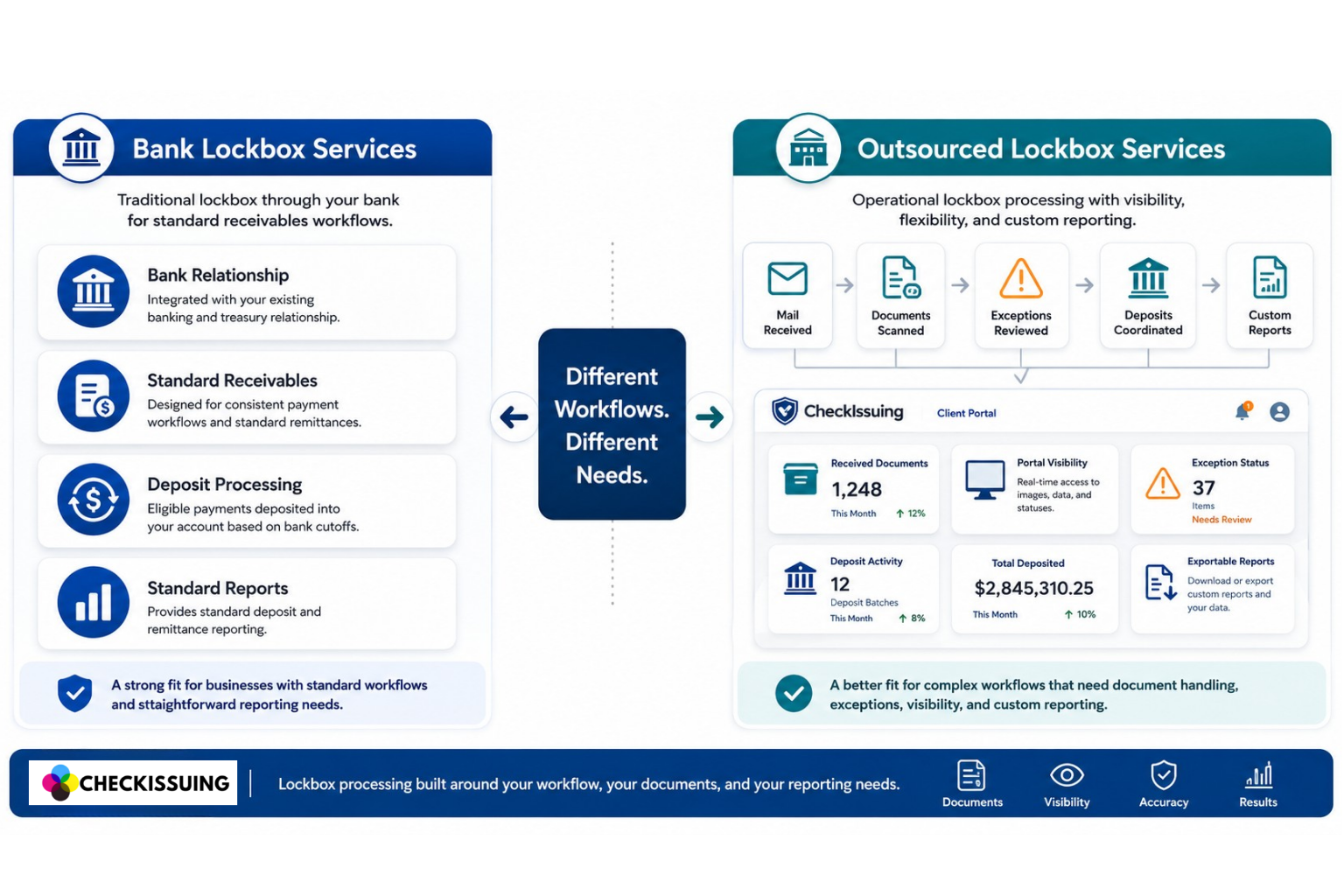
If your business still receives checks, remittance documents, invoices, claims, coupons, legal paperwork, healthcare documents, or other payment related mail, a lockbox process can help create a more controlled way to receive, review, deposit, and report on incoming payments.
For many organizations, the first option that comes to mind is a bank lockbox service. That can be a strong fit, especially when the payment workflow is standard and tied closely to a bank treasury relationship. But it is not the only option.
Outsourced lockbox processing is another model. Instead of relying only on a bank lockbox structure, businesses can work with a payment operations provider that supports inbound mail receipt, scanning, exception review, deposit coordination, portal visibility, and custom reporting based on the agreed workflow.
The right choice depends on what your team needs. A standard receivables workflow may be well served by a bank lockbox. A more document heavy, exception driven, multi entity, or reporting focused workflow may benefit from outsourced lockbox services.
Quick Answer Summary
Bank lockbox services are typically designed to support standard receivables and treasury management workflows within a banking relationship. Outsourced lockbox services focus on the broader operational workflow surrounding incoming payments, including document handling, exception review, portal visibility, deposit coordination, and custom reporting. Businesses with complex payment, document, or reconciliation requirements often benefit from the additional flexibility offered by outsourced lockbox processing.¹²
Key Takeaways
- Bank lockbox services are often integrated into treasury management programs and are well-suited for standardized receivables workflows.¹
- Outsourced lockbox services focus on the operational workflow behind incoming payments, including document capture, exception review, reporting, and payment visibility.²
- Businesses with complex payment environments often require support for invoices, remittance documents, claims, EOBs, rebate submissions, legal documents, and other payment-related records.²
- Portal visibility can provide teams with access to scanned documents, exception statuses, deposit activity, reports, and reconciliation support.
- Custom reporting becomes increasingly important for organizations managing multiple entities, departments, properties, cases, claims, patients, or accounts.
- Exception management workflows help organizations address missing information, mismatched payments, unclear documents, and approval requirements before they impact reconciliation.
- CheckIssuing positions outsourced lockbox processing as a payment operations service rather than simply a deposit service, combining lockbox workflows with ACH, digital checks, check mailing, rebate processing, document mailing, and 1099 services.
What Is a Bank Lockbox Service?
A bank lockbox service is a receivables service offered by a bank. Customers send payments to a lockbox address or P.O. box managed through the bank. The bank collects the mail, processes the checks, deposits eligible payments into the business account, and provides remittance information back to the business.
Bank lockbox services are often part of a broader treasury management relationship. For finance teams, this can be convenient because the deposit account, cash management tools, and receivables workflow may all sit within the same banking ecosystem.
A bank lockbox may be especially useful when payments are consistent, remittance documents are standardized, and reporting needs are fairly straightforward. For example, a business receiving regular check payments with predictable payment stubs may not need extensive customization.
What Is Outsourced Lockbox Processing?
Outsourced lockbox processing is a service where a business works with an external payment operations provider to manage inbound payment mail and related document workflows.
The provider may receive the mail, open and sort envelopes, scan checks and supporting documents, capture key details, flag exceptions, coordinate deposits based on the agreed setup, and make documents and reports available through a portal or reporting process.
The main difference is flexibility. Outsourced lockbox processing is often designed around operational workflow needs, not only the deposit. That can matter when incoming payments need to be matched to invoices, entities, departments, accounts, claims, cases, debtors, properties, patients, rebate submissions, or other internal references.
With CheckIssuing, the lockbox portal gives clients visibility into the operational work happening behind the scenes. Your team can see what came in, what needs review, what was deposited, and what reporting is available.
Key Differences Between Bank Lockbox and Outsourced Lockbox Services
Both models can help businesses move inbound check handling out of an internal office process. The difference is usually in flexibility, visibility, document handling, reporting, and support model.
| Category | Bank Lockbox Services | Outsourced Lockbox Services |
|---|---|---|
| Primary Focus | Deposit processing, treasury management, and standard receivables workflows. | Operational support for inbound checks, payment documents, visibility, exceptions, deposit coordination, and reporting. |
| Flexibility | Often best for standardized payment workflows tied to the bank relationship. | Often better suited for custom workflows by entity, department, account, document type, approval path, or reporting need. |
| Document Handling | May focus primarily on checks and standard remittance documents. | Can support checks plus related documents such as invoices, coupons, rebate claims, EOBs, legal documents, case documents, property references, and other payment-related mail. |
| Exception Review | May follow the bank process for standard exceptions. | Can be configured around the client review process for missing information, mismatched amounts, unclear documents, approvals, or routing needs. |
| Reporting | Often provides standard deposit and remittance reporting. | Can support custom reports and exports based on fields the team needs for posting, review, and reconciliation. |
| Portal Visibility | May provide bank portal access or treasury reporting depending on the bank setup. | Portal visibility can show scanned items, statuses, exception details, deposit activity, downloadable reports, and exportable data based on the agreed workflow. |
| Deposit Coordination | Usually tied directly to the bank deposit account and bank cutoff process. | Coordinated based on the agreed workflow, banking setup, cutoff timing, review needs, and deposit cadence. |
| Support Model | Often part of a broader commercial banking relationship. | Often more operational and workflow focused, with setup built around how the team actually handles payment mail. |
| Related Workflows | May be more limited to bank receivables services. | Can connect more naturally to related payment and document workflows such as check printing and mailing, digital checks, ACH, document mailing, rebate processing, and 1099 services. |
When a Bank Lockbox May Be a Good Fit
A bank lockbox service may be a good fit when the business has a standard receivables workflow and wants lockbox processing closely tied to its existing banking relationship.
This can work well when:
- Payments are mostly checks with standard remittance stubs.
- The business wants the bank to manage the deposit workflow directly.
- Reporting needs are simple and align with the bank format.
- There are limited exception handling requirements.
- The workflow does not require many custom fields, document types, approval paths, or routing rules.
- The organization already uses the bank for treasury management and wants to keep receivables services within that relationship.
For many businesses, that is enough. A bank lockbox can reduce internal check handling and help standardize mailed payment processing.
When Outsourced Lockbox Processing May Be a Better Fit
Outsourced lockbox processing may be a better fit when the challenge is not just depositing checks. It may be the operational work around the payment.
That work often includes reviewing documents, matching payment references, routing exceptions, preparing reports, coordinating deposits, and giving multiple teams visibility into status. Organizations increasingly operate across multiple payment channels and document workflows, making operational visibility and reconciliation support more important than traditional deposit processing alone.³
Outsourced lockbox services may be the better fit when your business needs:
- Visibility into received mail, scanned documents, statuses, exceptions, deposit activity, and reports.
- Custom reporting by entity, department, account, invoice, case, claim, debtor, payer, property, patient reference, or deposit batch.
- Support for documents beyond checks, such as remittance documents, coupons, invoices, EOBs, claims, legal documents, rebate submissions, or property related payment mail.
- Exception review for missing information, unclear documents, mismatched amounts, routing needs, or client approvals.
- Multi entity or multi account workflows that need separate tracking, reporting, or deposit coordination.
- A payment operations partner that can also support related services such as check printing and mailing, eChecks, ACH direct deposit, document and statement mailing, rebate processing, and 1099 services.
Why Portal Visibility Matters
A deposit total tells your team money came in. It does not always tell the full story.
Finance, AR, operations, legal, healthcare, property, rebate, and claims teams may need to know what arrived, when it was scanned, which documents support the payment, whether the item needs review, what deposit batch it belongs to, and whether a report is ready to download.
This is where portal visibility matters. The portal gives clients a clearer view into the lockbox work being performed behind the scenes.
Depending on the agreed setup, a portal backed lockbox workflow can give teams visibility into:
- Received documents
- Scanned check and document images
- Captured payment data
- Validation details
- Exception status
- Items needing action or review
- Approvals when approval is part of the workflow
- Deposit activity
- Downloadable reports
- Exportable data
That visibility can reduce back and forth between finance and operations because the team has one place to check status instead of relying on email updates, spreadsheets, or manual follow up.
Why Custom Reporting Matters
Standard lockbox reporting may work for straightforward receivables. But many teams need more than a list of deposits and check amounts.
A controller may need reporting by entity. A rebate team may need claim numbers and promotion codes. A property manager may need property and tenant references. A legal team may need case or matter numbers. A healthcare billing team may need patient references, EOB details, or payer information. A claims team may need case or claim IDs.
Custom reporting helps make lockbox data usable without forcing the team to rebuild the report manually after every processing cycle.
Possible custom reporting fields may include:
- Received date and processed date
- Client, entity, department, account, or location
- Payer name, debtor name, customer reference, or patient reference
- Invoice number, case number, claim number, matter number, rebate claim number, or property reference
- Check number, check date, amount, deposit batch, and deposit date
- Document type, status, exception status, exception reason, and reconciliation status
- Additional client specific fields agreed during setup
Why Document Handling Matters Beyond Checks
Many lockbox conversations focus on checks, but the check is often only one part of the workflow.
A mailed payment may arrive with a remittance document, invoice, payment coupon, claim form, rebate submission, EOB, legal document, case reference, property reference, debtor information, or other supporting paperwork. If that document is not captured and connected to the payment, the finance team may still need to chase missing details manually.
This is especially important for teams handling complex receivables or regulated documents. The ability to scan checks and related documents, capture the right fields, flag exceptions, and make reports available can be more valuable than the deposit alone.
That is why outsourced lockbox processing should not be treated as a general mailroom service. The focus is payment related mail, document capture, exception handling, deposit coordination, and reporting tied to the payment workflow.
How CheckIssuing Supports Full Service Lockbox Processing
CheckIssuing provides full service lockbox processing for businesses that need more visibility, structure, and flexibility around inbound checks and payment documents.
The workflow can support:
- Receiving inbound mail at the agreed address.
- Opening and sorting checks and related payment documents.
- Scanning checks, remittance documents, forms, invoices, claims, EOBs, legal documents, rebate documents, property references, and other payment related documents based on the agreed workflow.
- Uploading scanned items into the client portal.
- Capturing key payment and document details.
- Supporting validation and exception review.
- Routing items for client review when needed.
- Coordinating deposits based on the agreed banking setup, cutoff timing, deposit cadence, and review requirements.
- Making reports and exports available based on the fields the client needs.
CheckIssuing is not a bank. It is a payment operations partner that supports outsourced lockbox processing and related payment workflows. That includes lockbox services, check printing and mailing, digital checks, ACH direct deposit, document and statement mailing, rebate processing, 1099 services, and custom payment workflows.
This broader payment operations experience can be useful for businesses that do not want a check only lockbox setup or a generic mail scanning process. The goal is to create a practical workflow that helps the team track incoming payment mail from receipt through reports.
Final Takeaway
Bank lockbox services and outsourced lockbox services can both help businesses manage mailed payments. The best option depends on the complexity of the workflow.
If your payment process is standard, your reporting needs are simple, and you want the lockbox service closely tied to your bank account, a traditional bank lockbox may be the right fit.
If your team needs more flexibility around payment documents, exception review, portal visibility, custom reports, multi entity workflows, or related payment and document services, outsourced lockbox processing may be worth evaluating.
CheckIssuing Lockbox Services are built for businesses that need a clearer way to manage inbound checks and related payment documents. Explore CheckIssuing Lockbox Services or request a custom lockbox quote based on your volume, document types, deposit needs, and reporting requirements. Contact us, call us directly, or set up a meeting with our experts to get started.
Bank Lockbox Services vs Outsourced Lockbox Services FAQs
What is the difference between bank lockbox services and outsourced lockbox services?
Bank lockbox services are typically offered through a commercial bank and are often tied to the business banking relationship. Outsourced lockbox services are provided by a payment operations partner and may offer more flexibility around documents, exception handling, portal visibility, reporting, and custom workflows.
Are bank lockbox services still useful?
Yes. Bank lockbox services can be useful for standard receivables workflows, especially when the business wants the lockbox process tied closely to its deposit account and treasury management tools.
When should a business consider outsourced lockbox processing?
A business should consider outsourced lockbox processing when it needs more flexibility around document types, custom reporting, exception review, multi entity workflows, deposit coordination, or portal visibility into incoming payment mail.
Is CheckIssuing a bank?
No. CheckIssuing is not a bank. CheckIssuing provides outsourced payment operations services, including full service lockbox processing, check printing and mailing, digital checks, ACH direct deposit, document and statement mailing, rebate processing, and 1099 services.
Can outsourced lockbox services process documents beyond checks?
Yes. Depending on the agreed workflow, outsourced lockbox processing can support checks and related payment documents such as remittance documents, invoices, payment coupons, rebate claims, EOBs, legal documents, property references, case documents, and other payment related mail.
Can clients view scanned lockbox documents online?
With CheckIssuing, scanned items can be uploaded into the client portal based on the agreed setup. The portal can give teams visibility into scanned documents, captured data, exceptions, approvals when applicable, deposit activity, reports, and exportable data.
How are lockbox exceptions handled?
Exceptions are items that need review before moving forward. This may include missing information, unclear documents, mismatched amounts, approval requirements, or routing needs. With CheckIssuing, exceptions can be reviewed based on the workflow agreed during setup.
Are deposits instant with outsourced lockbox processing?
No. Deposits should not be described as instant. Deposit coordination depends on the agreed workflow, banking setup, mail receipt timing, cutoff timing, document complexity, exception review, and deposit cadence.
Can lockbox reports be customized?
Yes. Custom reporting can be configured around fields such as entity, department, account, payer, debtor, invoice, case, claim, property, patient reference, check number, amount, deposit batch, status, and exception reason.
What types of businesses use outsourced lockbox services?
Outsourced lockbox services are used by CFOs, controllers, finance teams, AR teams, operations leaders, healthcare billing teams, legal teams, real estate teams, escrow and title teams, rebate teams, claims teams, and enterprise operations teams that need better visibility into inbound payment mail.
Citations
- Association for Financial Professionals (AFP) – Payments Fraud and Control Survey – https://www.truist.com/content/dam/truist-bank/us/en/documents/info/cci/2026-afp-payments-fraud-control-survey-report-key-highlights.pdf
- U.S. Bank Treasury Management – Lockbox Automation Case Study – https://www.usbank.com/corporate-and-commercial-banking/treasury-payment-solutions/client-stories/healthcare-payment-consolidator.html
- Federal Reserve – Business Payments Study – https://fedpaymentsimprovement.org/wp-content/uploads/2024-federal-reserve-payments-insights-business-study.pdf