
Remote work reorganized where people do their jobs. It did not reorganize the destinations for checks, remittance documents, claim forms, and legal correspondence.
Lockbox services for remote teams exist precisely for this gap. When physical mail still reaches a fixed address, but the team is distributed, informal handling is not a sustainable answer.
Quick Answer Summary
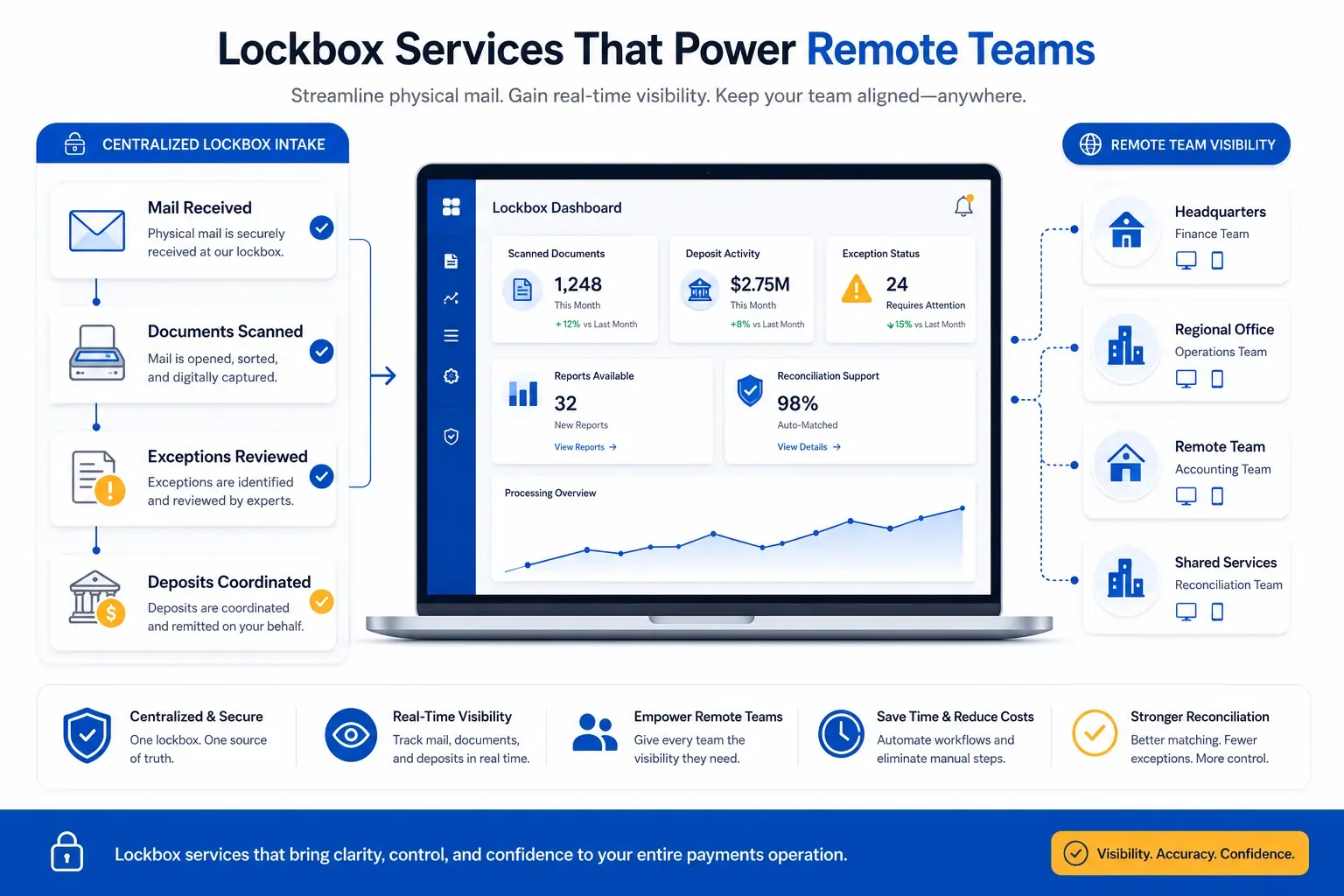
Lockbox services help remote teams manage physical mail workflows by creating a centralized intake process for checks, remittance documents, forms, and payment-related correspondence. Incoming items are received, scanned, indexed, reviewed, and organized through a structured workflow, giving distributed finance teams visibility into payment activity without relying on office visits, manual handoffs, or email-based document sharing.¹
Key Takeaways
- Lockbox services provide remote teams with a centralized process for receiving, scanning, routing, reviewing, and reporting on mailed payment documents.
- Portal visibility allows distributed employees to access scanned checks, remittance documents, exception statuses, deposit activity, and reports from any location.
- Structured intake workflows reduce reliance on informal mail handling, manual scanning, and email-based document sharing.
- Exception management helps organizations identify and resolve issues such as missing documentation, mismatched payment amounts, and routing errors before they create larger workflow delays.
- Lockbox payment processing supports reconciliation by connecting checks, remittance information, supporting documents, and deposit activity within a single workflow.
- Controlled intake processes help create an auditable record of received items and support organizations handling sensitive financial, healthcare, legal, or escrow-related documents.¹
- CheckIssuing combines full-service lockbox processing with portal visibility, exception review, deposit coordination, reporting, ACH, digital checks, check mailing, rebate processing, and 1099 services.
Why Physical Mail Becomes Harder to Manage Across Distributed Teams
Distributed teams create a mismatch that does not always announce itself until something goes wrong. Remote employees can access accounting systems, collaboration tools, and shared platforms from nearly anywhere. A mailed check cannot travel with them. It arrives at one address, and someone there must decide what to do with it.
That “someone” is often unclear. Responsibility for checking the P.O. box rotates informally. Mail gets retrieved only when someone visits the office. Scanned documents go out by email with no shared status record. Checks become separated from their remittance stubs.
When ownership is unclear and the team is remote, ordinary mail becomes a recurring operational gap.
How Lockbox Services Create a Structured Intake Process
Lockbox services give an organization a consistent physical intake point. Senders mail checks, forms, and documents to a designated address. The provider performs the operational work from there.
For CheckIssuing, that process includes:
- Receiving inbound mail at the agreed address
- Opening and sorting items
- Scanning checks and related documents
- Uploading scanned items into the client portal
- Supporting exception review
- Coordinating deposits based on the agreed workflow
- Making reports available
This is not a software-only product. CheckIssuing handles the physical and operational work. The portal gives remote employees visibility into what happened. That distinction matters because a portal with nothing behind it does not solve the problem of mail still arriving at a fixed location and needing to be processed.
How Remote Employees Gain Visibility Into Checks and Documents
Once items are scanned and indexed, employees do not need to be in the same building as the original envelope.
Depending on the configured workflow, portal access can allow a remote user to see what arrived, when it arrived, the scanned image, the associated entity or account, whether the item requires review, and what was included in a deposit batch. Reports become accessible without waiting for paperwork to be forwarded or asking someone at the office to re-scan something.
This is the practical value of document workflows organized around a full-service lockbox. The information contained in physical mail becomes available to the people who need it, wherever they work, rather than sitting in a mailroom waiting to be retrieved.
How Routing, Exception Review, and Reporting Reduce Workflow Gaps
Routing rules applied at intake replace informal email handoffs. When a settlement payment arrives, it can be tied to a case number. An insurance check can be matched with its explanation of benefits. A rebate submission can be assigned to the correct program.
The key is establishing those routing fields before processing begins. Without defined rules, items end up misrouted or held while someone figures out where they belong.
Exceptions follow the same logic. A missing remittance stub, a mismatched check amount, or an item addressed to the wrong entity are normal occurrences. The problem is when those items sit without a clear status. A useful exception workflow identifies the item, why it was flagged, who reviews it, and whether it has been resolved. Some items need a second look. That should not mean they disappear.
Reporting ties it together. Generic deposit totals are rarely enough for a distributed team. When a team tracks activity by entity, case number, claim, or department, the report should reflect that structure rather than requiring them to rebuild the data before they can use it.
How Lockbox Payment Processing Supports Deposits and Reconciliation
A deposited check tells you money arrived. It does not tell you who sent it, what it covers, or whether anything is missing.
Lockbox payment processing captures the check image and remittance information together, organized around how the client tracks payments. Finance and AR teams can see the sender, the related account or invoice, any accompanying documentation, and which deposit batch the item landed in. That context is available through the portal without anyone having to chase down the original paperwork.
The AFP Payments Fraud and Control Survey put check fraud at 58% of organizations in 2025. Informal handling makes that worse. When intake is centralized and access is controlled, there is a documented record of what arrived and who touched it. CheckIssuing supports SOC 2 and HIPAA-compliant workflows for teams managing sensitive records.
How Controlled Handling Protects Sensitive Physical Receivables
Physical documents can move through several hands when managed internally. Each informal handoff is an opportunity for something to be mislaid, accessed without authorization, or lost from the status record.
A structured intake process replaces that with documented receipt, controlled access, and an auditable history. The organization has a consistent, reviewable record of what arrived and what happened to it, rather than relying on an individual employee’s memory or a shared drive with inconsistent filenames.
For organizations managing physical receivables that include healthcare documents, legal correspondence, escrow records, or trust payments, a clear chain of custody is not optional.
What to Look for in a Lockbox Service Built for Remote Teams
A remote organization evaluating lockbox services for remote teams should work through a few practical questions before setting up:
- What types of items arrive by mail, and do they include documents as well as checks?
- What information needs to be captured from each item?
- How should items be routed by entity, account, case, or department?
- What defines an exception, and who reviews it?
- What deposit schedule and banking arrangement applies?
- Who needs portal access, and what should each role see?
Defining these details before the service begins is what makes the workflow consistent after it starts. A process that depends on someone at the office knowing the unwritten rules is not built for a distributed team.
For organizations that also handle outbound payments, CheckIssuing connects inbound lockbox with related services, including check printing and mailing, digital checks, ACH, rebates, and 1099s, reducing the number of vendors managing different parts of the same workflow.
Making the Physical Side as Manageable as the Digital Side
The digital side of most organizations has been carefully built out. Physical mail often did not get the same attention, partly because it was easier to manage when everyone worked in the same building. Remote work surfaces that gap in ways that are hard to ignore.
Lockbox services give physical mail intake the same structure the rest of the operation already has. CheckIssuing handles the operational work, and the portal gives distributed teams the visibility to do their jobs without needing to be near the envelope.
If your organization is still managing mailed checks, remittance items, or related documents through informal handoffs, let’s work through what a structured workflow could look like. Contact us, call us directly, or set up a meeting with the team to learn how CheckIssuing can support your team’s physical mail process.
Citations
- AFP Payments Fraud and Control Survey – 2026 Key Highlights
Truist / Association for Financial Professionals (AFP)
https://www.truist.com/content/dam/truist-bank/us/en/documents/info/cci/2026-afp-payments-fraud-control-survey-report-key-highlights.pdf