
Most payment tracking problems accumulate quietly and gradually through missed updates, duplicate entries, and handoffs between systems that were never meant to talk to each other. Checks are still part of how most businesses pay vendors. The Federal Reserve’s 2025 business payments research found that 73% of surveyed businesses used checks in the past year. Without check writing software online, keeping an accurate record of where each payment stands turns into a daily guessing game.
Quick Answer Summary
Payment tracking inconsistencies occur when businesses rely on manual processes, fragmented systems, and delayed updates. Without check writing software online, errors like duplicate entries, missing records, and unclear payment status become common. Centralized systems solve this by providing real-time visibility, consistent data, and a complete audit trail.
Key Takeaways
- Fragmented systems cause inconsistent payment records and visibility gaps¹
- Manual data entry leads to errors that compound over time²
- Lack of automation increases costs and operational inefficiencies¹
- Delayed reconciliation distorts cash flow and financial accuracy²
- Centralized software reduces fraud risk and improves tracking consistency²
Why Payment Tracking Falls Apart Without a Centralized System
Nobody designs a fragmented payment process on purpose. It just happens that way.
Check requests arrive by email. Approvals get handled in a chat. Someone prints locally, someone else logs the payment in a spreadsheet, and the bank portal gets updated whenever someone has time. Each step lives somewhere different, owned by a different person, updated on a different schedule.
The result is that when a vendor calls about a missing payment or when someone needs to close the books, no one has a clean answer. Check writing software consolidates that activity into a single workflow. Without it, even the basic question, like has this check cleared or is it still out there? requires more effort than it should.
Common Sources of Payment Tracking Inconsistencies
The inconsistencies rarely come from one source. Usually, they stack on top of each other, and by the time anyone notices, the records have drifted far enough from reality that fixing them is a project.
Manual Data Entry Creates Small Errors That Compound Over Time
Hand-keying payment details across multiple systems is where most of the quiet damage happens. Common AP accuracy problems include duplicate invoices, data entry mistakes, vendor master file inaccuracies, pricing discrepancies, and overlooked invoice reviews. A vendor name entered slightly differently in two places. A check number that does not match between the spreadsheet and the accounting system. A payment amount that reflects a different invoice revision than the one that was approved.
None of these feels serious when they happen. But they surface eventually during reconciliation or a vendor dispute or, worse, an audit, and by then, the original source of the mismatch is hard to find.
Fragmented Workflows Limit Visibility Into Payment Status
The Federal Reserve’s 2025 business payments data showed that 28% of businesses cited lack of automation as a payment pain point, while 48% pointed to total costs from exceptions and manual processes. What those numbers reflect, at the operational level, is that people are spending real time on questions that a structured system would answer automatically.
Without check printing software connecting each step, one person ends up re-checking bank statements, another follows up with vendors directly, and someone else patches the spreadsheet. They are all doing the same job, just from different angles, because no single source reflects current payment status.
Real-time USPS tracking can eliminate much of that back-and-forth by surfacing delivery status automatically rather than requiring manual follow-up.
Documentation Gaps Create Problems During Tax Season and Audits
The IRS expects businesses to keep supporting documents, like invoices, approvals, and vendor W-9s, connected to their payment records. In a manual workflow, that connection is rarely maintained. The check gets recorded in the accounting system. The invoice lives in an email folder. The W-9 is somewhere in a filing cabinet from two years ago.
That scattered setup is manageable day-to-day. It stops being manageable when someone needs to pull up documentation for a specific payment from seven months ago, or when a 1099 needs to be verified before filing.
Check printing services that support document attachment give teams a way to keep the full record together from the start, so tax prep is not a reconstruction project.
Delayed Reconciliation Leads to Outdated Cash Flow Data
When reconciliation happens weekly or monthly, the ledger is always a little behind. A check recorded as issued may have already cleared. Another may have been voided but still shows as outstanding. Over time, those gaps distort what the cash position looks like.
According to the Association for Financial Professionals (AFP), 62% of treasury practitioners consider cash or liquidity forecasting their most challenging task. Inconsistent payment records make that harder than it needs to be. Outstanding checks that should have been removed from the books weeks ago can make available cash look smaller or larger than it really is. Neither version is useful.
Weak Controls Increase Fraud and Duplicate Payment Risk
The AFP adds that 79% of organizations experienced attempted or actual payment fraud. Check fraud specifically was reported by 63%. Those numbers are high partly because manual processes give fraudulent activity more room to go unnoticed.
If the issued-check register is maintained in a spreadsheet and approvals happen informally, there is no built-in mechanism to flag a duplicate payment before it goes out, or to catch an altered check before it clears. Standardized policies for invoice validation and payment processing reduce confusion and the manual rework that follows when things go wrong. Informal systems tend to skip that standardization.
How Check Writing Software Online Eliminates These Inconsistencies
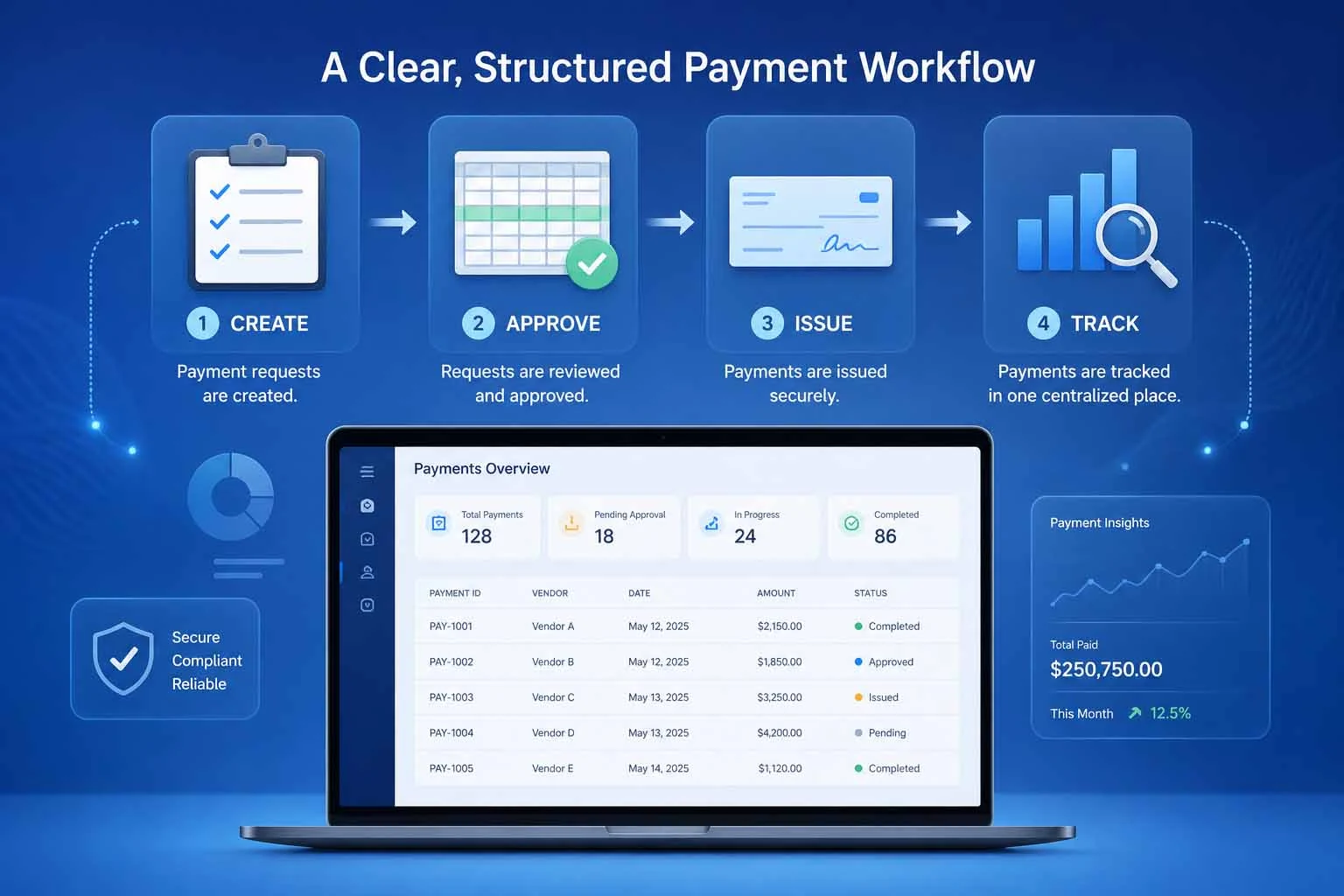
Check writing software online works by replacing the scattered handoffs with one structured workflow. Payment creation, approval, issuance, and tracking happen in the same place, which means there is no re-entry, no version drift, and no status mystery.
The practical differences include:
- Vendor data, check numbers, and payment amounts stay consistent because they are entered once and carried through
- Payment status updates in real time without manual checking
- Approval rules and access controls reduce the informal sign-off problem
- Documents attach to the payment record rather than living elsewhere
- Reconciliation reflects what has happened, not what was last updated manually
| Factor | Manual / Fragmented Tracking | Centralized Check Writing Software |
|---|---|---|
| Data Entry | Repeated across systems, prone to errors | Entered once, consistent across all records |
| Payment Status Visibility | Unclear, requires manual follow-up | Real-time tracking and updates |
| Workflow Management | Scattered across email, chat, spreadsheets | Centralized workflow with approvals built in |
| Error Risk | High (duplicates, mismatches, omissions) | Low (automated validation and controls) |
| Reconciliation | Delayed and manual | Faster, accurate, and automated |
| Audit & Documentation | Scattered and difficult to retrieve | Centralized audit trail with attached documents |
| Fraud Detection | Limited visibility, higher risk | Improved controls and anomaly detection |
What Finance Teams Should Look for in a Solution
The best check writing software handles more than check production. Online access, searchable payment history, AP reporting, reconciliation support, vendor management, and secure document storage all matter. So does built-in support for tasks like 1099 preparation, which can otherwise require significant manual effort at year-end.
The underlying goal is one place where payment creation, approval, issuance, tracking, and documentation all live. When that exists, finance teams stop spending time confirming things they should already know.
Let Us Help You Eliminate Payment Tracking Inconsistencies
Fragmented manual processes are the root cause. The entry errors, the visibility gaps, the delayed reconciliation, and the fraud exposure all come from the same place: payment workflows that were never designed to give anyone a complete picture.
CheckIssuing provides online check writing software services that bring those workflows together. From check writing and mailing through real-time status tracking and documentation, the platform is built to close the gaps where inconsistencies take hold. If your team is still spending time chasing down payment statuses or patching together records at month-end, contact us, call us, or set up a meeting with the team. We can show you what a cleaner process looks like.
Citations
- Federal Reserve – Business payments research highlighting check usage and automation challenges
https://fedpaymentsimprovement.org/wp-content/uploads/business-payments-report.pdf - Association for Financial Professionals – Data on fraud rates, operational inefficiencies, and financial management challenges
https://www.financialprofessionals.org/training-resources/resources/articles/Details/benchmarks-for-financial-professionals-20-key-stats-on-salaries-fraud-and-tech