
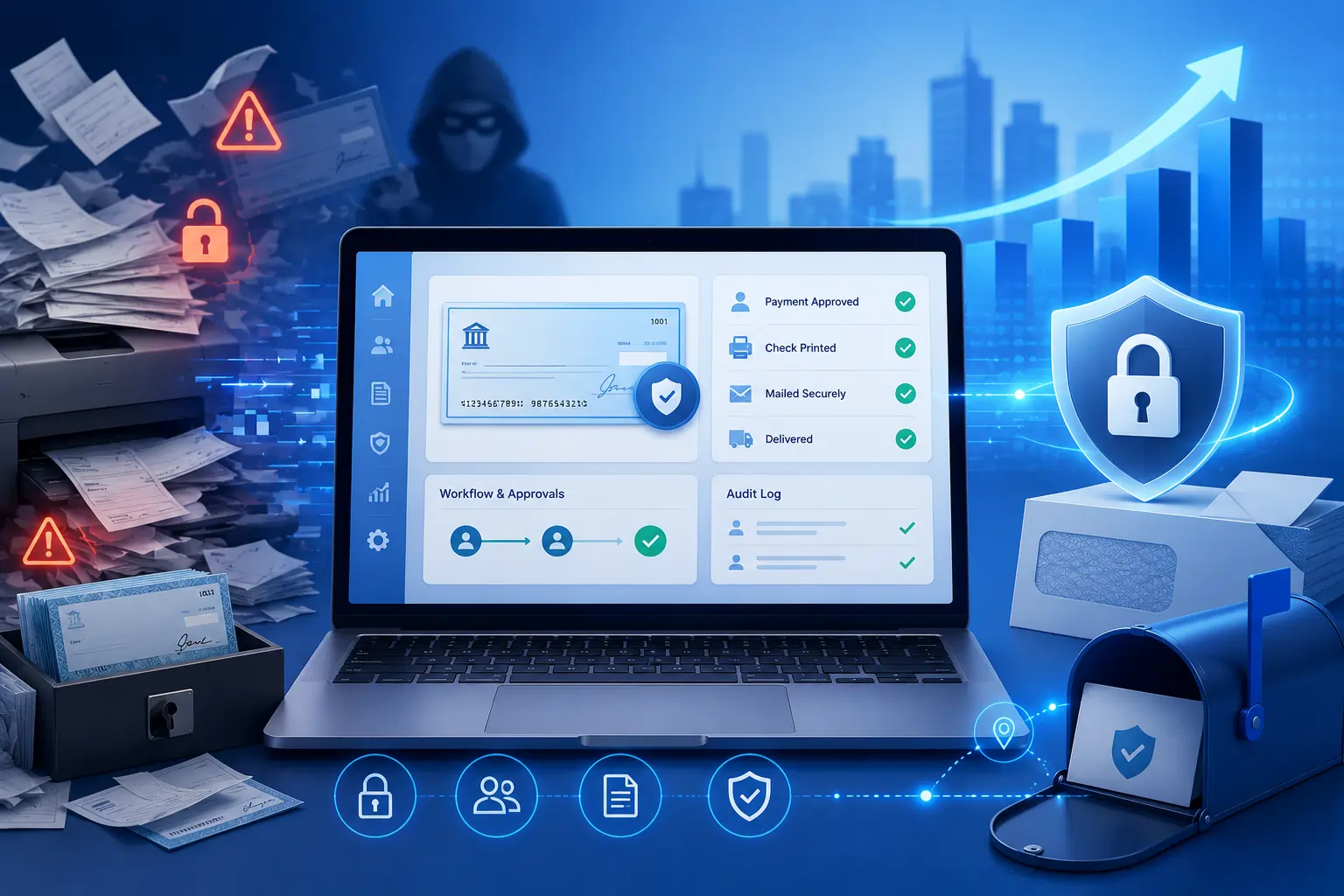
A check process that works at 50 monthly payments can become a liability at 500. Most growing companies don’t overhaul their payment operations on a schedule. They keep what worked, add volume, and eventually find gaps they didn’t see coming.
Without secure check printing, those gaps tend to compound. Fraud gets harder to catch, errors get more expensive to fix, and the paper trail finance teams need for audits grows thinner. Check printing services exist to stop that pattern before it starts.
Quick Answer Summary
As companies grow, informal check printing processes often become security and operational risks. Without secure check printing controls, businesses face higher exposure to fraud, payment errors, unauthorized access to banking data, weak audit trails, and mail theft-related check washing schemes. Secure check printing software and managed check printing services help reduce these risks through controlled workflows, approval systems, tracking, and layered security.
Key Takeaways
- Growing companies often outgrow informal check printing workflows before they realize the risks involved¹
- Check fraud remains one of the most common forms of payment fraud affecting businesses²
- Weak internal controls increase the likelihood of unauthorized payments and reconciliation issues³
- Secure check printing software helps reduce fraud exposure through role-based access, approval workflows, and audit logs⁴
Growing Companies Often Outgrow Informal Check Processes
Early-stage check habits feel fine when vendor counts are low. An office printer, a stack of blank stock, manual signatures, and a spreadsheet hold it together.
What changes as a company scales isn’t just volume. It’s the number of people touching payments, the variety of vendors in rotation, and the surface area where something can go wrong. Approved bank data starts sitting on shared printers. Templates live on computers without access restrictions. Check stock ends up stored wherever there’s room. Finance staff who once managed everything informally are now stretched across exceptions, reissues, and approvals they can barely keep up with.
The risk isn’t using checks. It’s using checks without layered controls while the operation around them keeps growing.
Check Fraud Becomes Harder to Control at Scale
Check fraud doesn’t fade as businesses modernize. It scales right alongside payment volume, and recent data makes that hard to ignore.
AFP’s 2026 payments fraud survey found that 76% of organizations experienced attempted or actual payments fraud in 2025, with 58% reporting check fraud, the most frequently impacted payment method that year. A 2025 AFP report found that 23% of organizations experienced check fraud tied specifically to mailbox theft, and 75% had no plan to stop using checks within two years.
More outgoing checks means more mailed items, more vendors, more exposure. Without secure check printing controls, every check that leaves the business is a potential point of failure, and companies writing hundreds of checks a month have hundreds of potential points of failure each cycle.
Unsecured Check Printing Exposes Sensitive Banking Information
Every check carries an account number, routing number, business name, signature area, and payee details. Anyone who intercepts or copies one has most of what they need to do real damage.
Banking information extracted from checks can enable unauthorized ACH debit fraud, meaning exposure doesn’t stop at the check itself. Shared printers running check templates, preprinted stock left in unlocked drawers, and print files sitting in general company folders all create openings that are easy to miss until something goes wrong.
Check printing software limits access at the source. Print runs require authorization, activity gets logged, and sensitive payment data stays out of general workflows. That’s a meaningful structural change from the informal setups most growing companies inherit.
Manual Workflows Create Errors and Delays
Manual check printing is prone to mistakes in ways that are predictable but still costly. Payee names get mistyped. Amounts get transposed. Duplicate checks get issued when AP staff don’t have a shared view of what’s already been processed. Approvals get skipped in a rush.
Checks carry higher error rates because of the manual handling they require, and that resolving lost or stolen checks adds time and cost that compounds across a growing payment volume. A duplicate payment or misdirected check at low volume is an inconvenience. At scale, it’s stop-payment fees, reissue labor, vendor friction, and a delayed close.
Check printing services that pull from approved payment records rather than relying on manual data entry reduce these errors at the point where they originate.
Weak Internal Controls Open the Door to Unauthorized Payments
As companies grow, more people touch the payment process. AP staff, controllers, remote employees, and office managers all tend to acquire some role in approvals, check issuance, or reconciliation, often without any formal structure around it. That kind of informal expansion becomes hard to track quickly.
According to the NJCPA, no single person should initiate, authorize, record, and review a payment on their own. The Federal Reserve’s check fraud prevention guidance recommends dual controls, restricted access to check issuance, and a clear separation between whoever signs checks and whoever handles reconciliation.
Check printing software puts that structure into practice through role-based permissions and approval workflows. Check numbers, timestamps, approval history, and void records are all preserved automatically, so audit questions don’t require hours of manual digging. Those logs matter most when things go sideways. Vendor disputes, tax reviews, and fraud investigations tend to surface exactly the documentation gaps that informal processes leave behind.
Mail Theft and Check Washing Create Additional Exposure
Once a check leaves the building, a different set of risks takes over. FinCEN reported that financial institutions filed 15,417 Bank Secrecy Act reports tied to mail theft-related check fraud over a six-month review period, totaling more than $688 million in suspicious activity. Of those stolen checks, 44% were altered and deposited, 26% were used as templates for counterfeit checks, and 20% were fraudulently signed and deposited.
Check washing is worth understanding on its own terms. A fraudster intercepts a mailed check, alters the payee name or dollar amount, and deposits it. Low-security stock makes that process easier. Check printing companies that control production and fulfillment close that window. Real-time USPS tracking and secure mailing workflows also tell businesses exactly what was sent and whether it reached the right hands.
How Secure Check Printing Software and Services Restore Control
Check printing software replaces informal habits with structure. Role-based access, approval requirements, print logs, check number sequencing, and payment data integration all reduce the manual steps where fraud and errors tend to enter.
Check printing services work differently but address related problems. Production, quality control, fulfillment, and mailing happen outside the company in a controlled environment, which reduces internal access points and applies consistent standards even when internal teams are stretched or changing.
Together, they turn disbursements from something loosely managed into something traceable and repeatable.
| Informal Check Process | Secure Check Printing Process |
|---|---|
| Shared printers and unsecured check stock | Restricted access and controlled production environments |
| Manual approvals and inconsistent workflows | Role-based permissions and approval routing |
| Limited payment tracking and documentation | Automated audit trails and payment logs |
| Higher risk of duplicate payments and data entry errors | Integrated payment records and validation controls |
| Greater exposure to mail theft and check washing | Secure mailing workflows and tracking visibility |
Scale Check Payments More Safely With CheckIssuing
Growing without updating check payment processes tends to leave companies managing fraud response, payment errors, internal control gaps, and reconciliation problems all at once. Those problems don’t resolve on their own.
At CheckIssuing, we provide secure check writing and mailing services for businesses that need stronger controls as they scale. Whether the goal is reducing access risk, cleaning up the audit trail, or taking fulfillment off a stretched finance team, we can help. Contact us, call us, or set up a meeting with our experts today, and let’s find the right setup for where your operation is headed.
Citations
- AFP Payments Fraud and Control Survey 2026: https://www.truist.com/content/dam/truist-bank/us/en/documents/info/cci/2026-afp-payments-fraud-control-survey-report-key-highlights.pdf
- AFP Payments Fraud and Control Survey 2025: https://www.truist.com/content/dam/truist-bank/us/en/documents/info/cci/2025-afp-payments-fraud-control-survey-report-key-highlights.pdf
- NJCPA – Why Segregation of Duties Is Essential for Internal Control: https://www.njcpa.org/article/2024/09/23/why-segregation-of-duties-is-essential-for-internal-control
- FinCEN – Mail Theft Related Check Fraud Analysis: https://www.fincen.gov/news/news-releases/fincen-issues-depth-analysis-check-fraud-related-mail-theft