
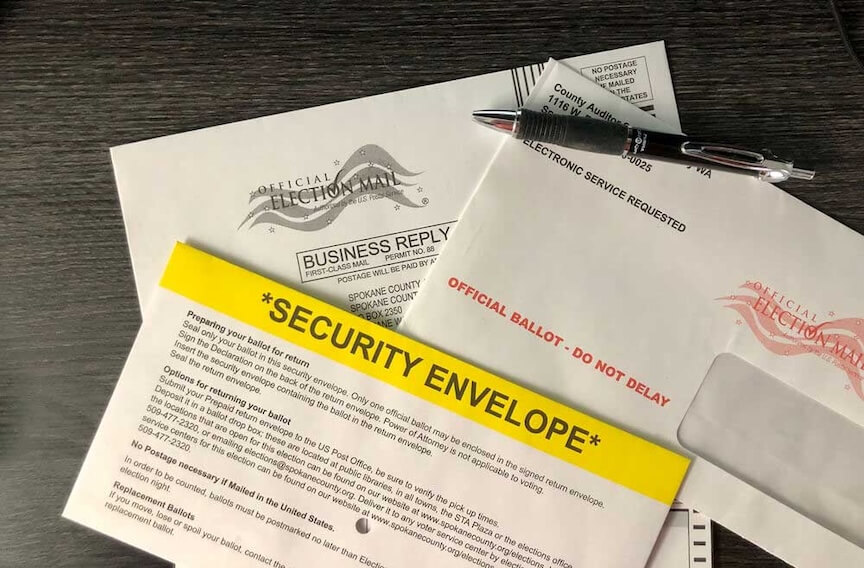
In all likelihood, you’ve seen a security envelope before, but you may not have known what it was, why companies use it, or how it is significant in protecting your data. Companies that choose to mail sensitive documents should ideally use these security envelopes to ensure that private information remains confidential. Here are answers to some common questions and concerns about security envelopes.
Quick Answer Summary
Security envelopes are specially designed mailing envelopes that help protect confidential information from being viewed through the envelope. Businesses commonly use them when mailing checks, bank statements, payroll documents, healthcare information, tax forms, and other sensitive records to reduce the risk of identity theft and mail-related fraud.¹²
Key Takeaways
- Security envelopes use interior security patterns and opaque paper to prevent sensitive information from being read through the envelope.¹
- They are commonly used to mail checks, payroll documents, bank statements, healthcare records, tax forms, legal documents, and other confidential correspondence.²
- Using security envelopes helps reduce the risk of identity theft, check fraud, and unauthorized disclosure of personal or financial information.³
- Organizations that regularly mail confidential documents often incorporate security envelopes into a broader document security and compliance strategy.²⁴
- Outsourcing secure printing and mailing can help businesses improve efficiency while maintaining consistent document protection.⁴
What Is a Security Envelope?
Typically, if you receive official mail, it comes in a windowed envelope. The printed name of the recipient appears on the official document for address and shipping purposes. These envelopes often contain important documentation, such as:
- Billing statements and account information
- Credit cards, health insurance plans, and Social Security cards
- Bank account information, such as monthly bank statements
- Paychecks and payroll information
- Offers of employment, leasing documents, and other types of legal documents
The information included in these types of documents is often sensitive and highly personal. Corporations that send confidential information through the USPS or other forms of mail must ensure that this information remains secure and uncompromised by unintended parties. Therefore, taking advantage of security measures such as security envelopes is beneficial.
Security envelopes resemble traditional envelopes, such as those sold at your local store. In fact, from the outside, they often appear to be almost identical. When comparing a traditional security envelope to a regular envelope, the primary difference is that security envelopes feature windowed partitions and are made from thicker paper.
However, once you’ve opened the envelope, you can quickly tell the difference between the two. Inside security envelopes, you’ll see a gray lining with a black pattern. The security envelope pattern protects personal information by making it impossible to hold the envelope up to the light and see through it. While it may seem unnecessary for mailed items, this type of protection is an important security feature that helps keep sensitive information safe from prying eyes.
| Document Type | Use a Security Envelope? | Why It Matters |
|---|---|---|
| Payroll checks | ✅ Yes | Protects employee financial information and paycheck details. |
| Bank statements | ✅ Yes | Helps prevent unauthorized viewing of account balances and banking information. |
| Tax documents | ✅ Yes | Protects Social Security numbers, tax information, and other sensitive personal data. |
| Insurance documents | ✅ Yes | May contain confidential personal or healthcare-related information. |
| Legal correspondence | ✅ Yes | Helps safeguard contracts, legal notices, and confidential communications. |
| Marketing flyers | ❌ Usually No | Typically do not contain confidential or personally identifiable information. |
| General letters | ❌ Usually No | Standard envelopes are generally sufficient when no sensitive information is included. |
How Security Envelopes Are Used for Check Fraud Prevention
Ensuring that checking information arrives securely keeps everyone safe. Traditional, thin envelopes are great for mailing letters and other non-sensitive items. However, if you’re mailing items that contain sensitive information, ensuring envelopes are not see-through is vital for personal security and fraud prevention.
Typically, regular envelopes are thin enough that individuals can hold them up to a bright light and read through them. In the past, see-through envelopes were responsible for approximately half of all check fraud. Scammers would take mail from individuals’ mailboxes, review the information on check stubs or other sensitive documents, and use it for fraudulent purposes. Some ways individuals could use the information they read through an envelope include, but are not limited to:
- Stealing Social Security numbers exposed through see-through envelopes
- Acquiring routing and checking account numbers to produce fraudulent checks and to make illegitimate purchases
- Canceling or altering health care plans, stopping payments from going to their intended recipients, and other malicious acts
- Impersonating individuals to receive further sensitive information
- Gathering information to be used for blackmail purposes at a later time
Because the envelopes were see-through, many victims of this kind of fraud were none the wiser. Their mail was perfectly intact and unopened. Therefore, finding a solution to keep correspondence safe and secure and prevent unauthorized access to sensitive information became necessary.
Ultimately, security envelopes use patterns, typically on a gray or light purple background, to obscure the text, making it distorted and difficult to read. The patterning on the inside of the envelope effectively hides and protects potentially sensitive information, making mailing documents more secure.
What Is the Standard Security Envelope Pattern?
Now that you know what security envelopes look like, you can probably think of a few times you’ve seen them. You may have even received a few official documents in security envelopes before.
Currently, there are over 300 different types of security envelope patterns to choose from. The exact kinds of designs vary depending on the company that produces them. Typically, however, they have the following characteristics:
- Designs are close together to keep text from being easily read.
- Dark colors, usually black or navy blue, are used to blend in with the text.
- Envelopes have a gray or light-purple background.
The overall goal of these designs is to block text and make it difficult to decipher under bright lights. By making text hard to read through close or overlapping designs, individuals would have to tamper with the mail to read it. Overall, the use of security envelopes reduces the risk of private and sensitive data falling into the wrong hands.
How Much Do Security Envelopes Cost?
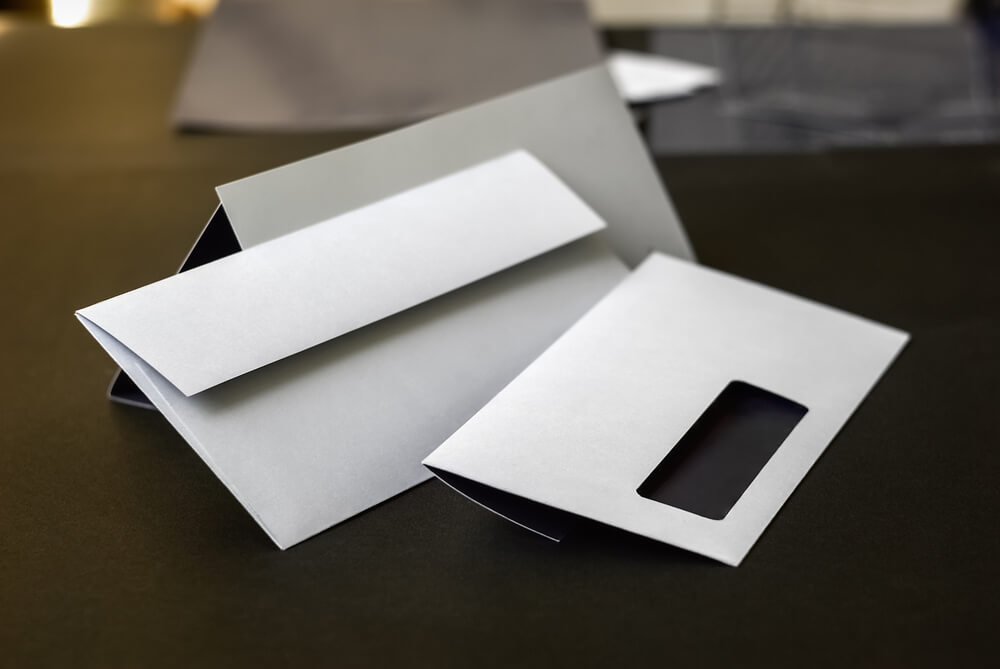
Though security envelopes help check fraud prevention and keep private data secure, the cost is always a concern. However, companies that send sensitive information by mail are often required by law to take precautions to prevent identity theft. Research about the cost of making and purchasing security envelopes versus the cost of alternative security measures shows that it is actually more affordable to use these envelopes.
Alternative and approved methods for securing data include enclosing documents and information in thick paper, using multiple envelopes when mailing documents, and employing other techniques. While it may be more cost-effective to ship these types of documents once or twice using an alternative method, companies mailing large quantities of secure items can save hundreds of dollars by using security envelopes.
Naturally, not every type of document requires a security envelope for shipping. Documents that do not contain sensitive information and that are sent in regular, store-bought envelopes are sufficient. However, sending all of your mail in security envelopes is a great way to protect the privacy of the sender and the recipient. Ultimately, using security envelopes all the time may not be the most cost-effective way to send your mail, realistically speaking. In many cases, security envelopes cost more than traditional envelopes, thanks to the unique features that help shield personal information from unwanted browsing.
Overall, security envelopes are an essential part of protecting the data of hundreds of thousands of individuals worldwide. They also protect business owners and corporations from liability lawsuits and other serious legal issues. Ultimately, they provide a solution to the problem of undetectable identity theft, helping to keep everyone safe. Whether you need to purchase a few security envelopes or are interested in having your checks or other documents sent securely, these envelopes provide a great solution.
Protect Sensitive Documents With Secure Mailing Solutions
Whether you’re mailing payroll checks, bank statements, rebate checks, tax forms, invoices, or other confidential business documents, protecting sensitive information should be part of every mailing process. CheckIssuing provides secure check printing, document mailing, security envelopes, ACH, eChecks, lockbox services, and payment solutions designed to help businesses protect confidential information while improving operational efficiency.
Contact us, call our team, or schedule a meeting today to learn how CheckIssuing can help simplify your secure document and payment workflows.
Citations
- Wikipedia. Bank Statement. https://en.wikipedia.org/wiki/Bank_statement
- United States Postal Inspection Service. Mail Fraud & Identity Theft Prevention. https://www.uspis.gov/tips-prevention/identity-theft
- Federal Trade Commission. Identity Theft. https://consumer.ftc.gov/identity-theft-online-security
- National Institute of Standards and Technology (NIST). Protecting Sensitive Information. https://www.nist.gov/news-events/news/2024/05/nist-finalizes-updated-guidelines-protecting-sensitive-information
Last updated: September 2025